
Female Infertility Tests: AMH, Ultrasound, Hormones, HSG
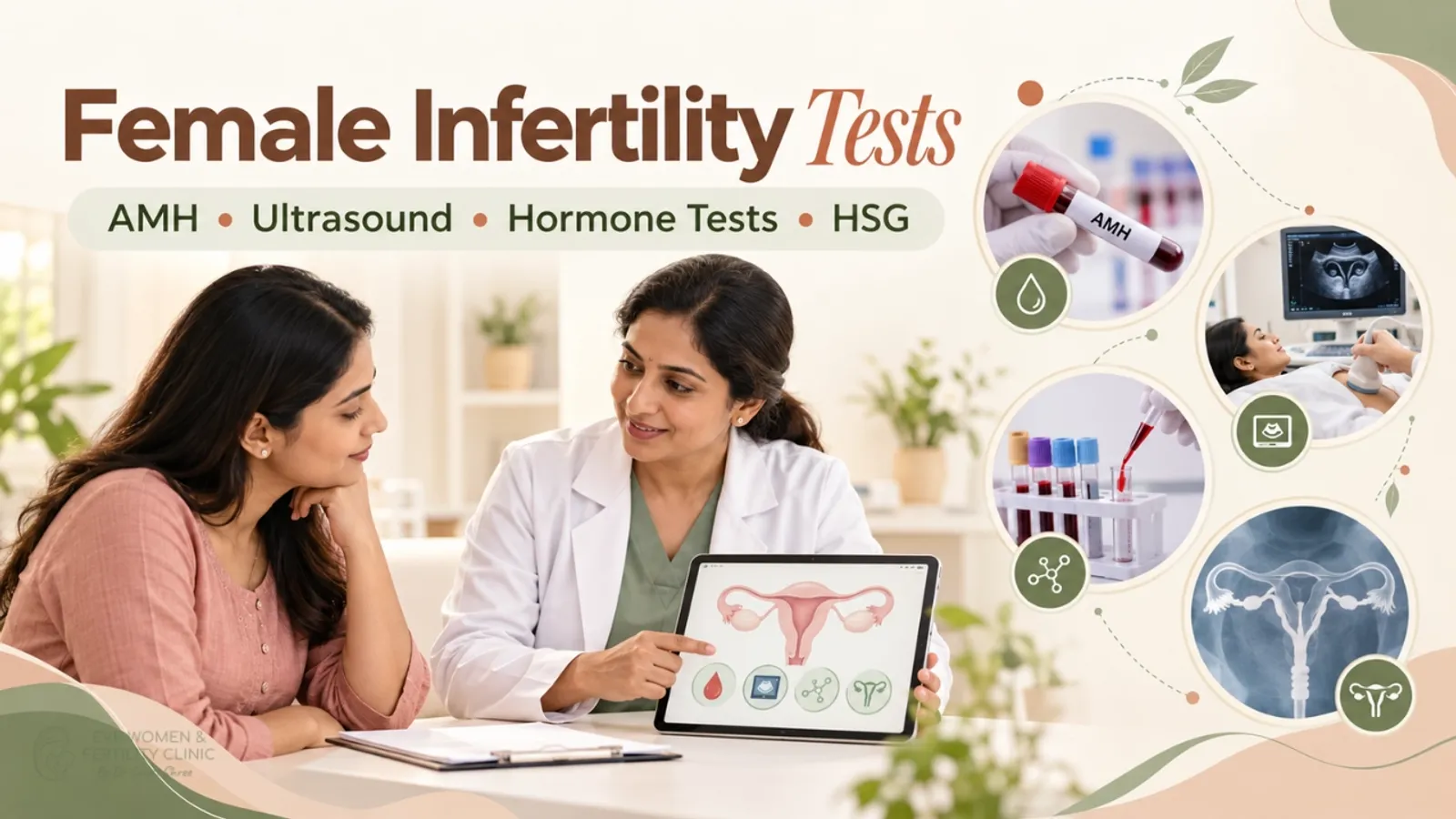
Quick answer: Common female fertility tests include AMH and an antral follicle count to estimate ovarian reserve, transvaginal ultrasound to examine the uterus and ovaries, hormone tests such as FSH, LH, oestradiol, thyroid function and prolactin, a mid-luteal progesterone test to confirm ovulation, and HSG or sonography to check whether the fallopian tubes are open. The exact tests depend on age, history and symptoms.
When pregnancy does not happen as expected, fertility testing helps identify possible causes and guide treatment. Female fertility evaluation looks at ovulation, egg reserve, the fallopian tubes and the uterus. Testing for the male partner is done at the same time, since both partners contribute.
This article is part of our female infertility guide.
What does AMH show?
Anti-Mullerian hormone is made by small follicles in the ovaries. Its level gives an estimate of ovarian reserve, meaning the number of eggs remaining. It helps predict how the ovaries may respond to IVF stimulation. AMH does not measure egg quality and cannot predict natural fertility accurately on its own.
What does a transvaginal ultrasound check?
A transvaginal scan examines the uterus and ovaries. It can detect fibroids, polyps, ovarian cysts, endometriomas and signs of PCOS. It is also used to count antral follicles, small follicles in early cycle that reflect ovarian reserve.
Which hormone tests are done?
Day 2 to 3 FSH, LH and oestradiol
These early-cycle tests help assess ovarian function and identify problems such as diminished ovarian reserve or PCOS patterns.
Progesterone
A mid-luteal progesterone level, about a week before the expected period, helps confirm whether ovulation occurred.
Thyroid tests (TSH)
Thyroid problems can affect ovulation and pregnancy.
Prolactin
High prolactin can disrupt ovulation.
Androgens
Testosterone and related tests may be done if PCOS is suspected.
How are the fallopian tubes checked?
Hysterosalpingogram (HSG)
Dye is passed through the cervix and X-ray images show whether the tubes are open and the uterine shape.
Sonohysterosalpingography (HyCoSy or HyFoSy)
An ultrasound-based alternative using fluid or foam, without radiation.
Laparoscopy
A surgical camera test used when other tests suggest tubal disease or endometriosis.
Are other tests needed?
- Rubella immunity and infection screening such as HIV, hepatitis B and C
- Blood count and blood group
- Vitamin D or other tests based on history
- Hysteroscopy if an abnormality of the uterine cavity is suspected
When should testing start?
Testing is usually recommended after 12 months of trying under age 35, after 6 months at 35 or older, and sooner if periods are irregular, there is known endometriosis, previous pelvic surgery or infection, or the woman is over 40.
Key Takeaways
- Fertility testing checks ovulation, ovarian reserve, tubes and uterus.
- AMH estimates egg quantity, not quality.
- Ultrasound detects uterine and ovarian problems.
- HSG checks whether tubes are open.
- Both partners should be tested together.
Final Thoughts
The right tests give a clear picture and help avoid unnecessary delays. Your fertility specialist will select tests based on your history. Dr. Swati Shree at Eve Women and Fertility Clinic in Bengaluru provides complete fertility evaluation.
FAQs
What tests are done for female infertility?
Common tests include AMH, transvaginal ultrasound with antral follicle count, hormone tests such as FSH, LH, oestradiol, TSH and prolactin, progesterone to confirm ovulation and HSG to check the tubes. The standard set is AMH and other hormone blood tests, a pelvic ultrasound with antral follicle count, a tubal check such as HSG or HyCoSy, and a mid-luteal progesterone test. Your partner's semen analysis runs alongside.
What does a low AMH mean?
Low AMH suggests a lower egg reserve. It does not mean you cannot conceive and does not measure egg quality. It helps plan treatment, especially IVF. It means the ovary's egg reserve is smaller than average for your age. It does not mean you cannot conceive, because it says nothing about egg quality. It mainly guides how urgently to plan treatment.
Is the HSG test painful?
Many women feel cramping similar to period pain during HSG. Taking pain relief beforehand as advised can help. Discomfort usually settles quickly. Most women feel brief period-like cramps while the dye passes through the tubes, settling within minutes. A painkiller beforehand helps. If a tube is blocked, pressure can build up and cause stronger but still short-lived pain.
When should I get fertility tests?
Usually after 12 months of trying under 35, after 6 months at 35 or older, and earlier with irregular periods, endometriosis, previous pelvic surgery or age over 40. After 12 months of trying under 35, or after 6 months if you are 35 or older. Come sooner with very irregular periods, known tubal damage, severe period pain or a previous pelvic infection.
Does my partner need testing too?
Yes. Male factors contribute to many cases of infertility. A semen analysis is usually done at the same time as female testing. Yes. Male factors play a role in around a third of couples, and a semen analysis is far simpler than the tests women undergo. Testing both partners together avoids months of one-sided investigation.