
Female Infertility: Causes, Signs, Tests and Treatment
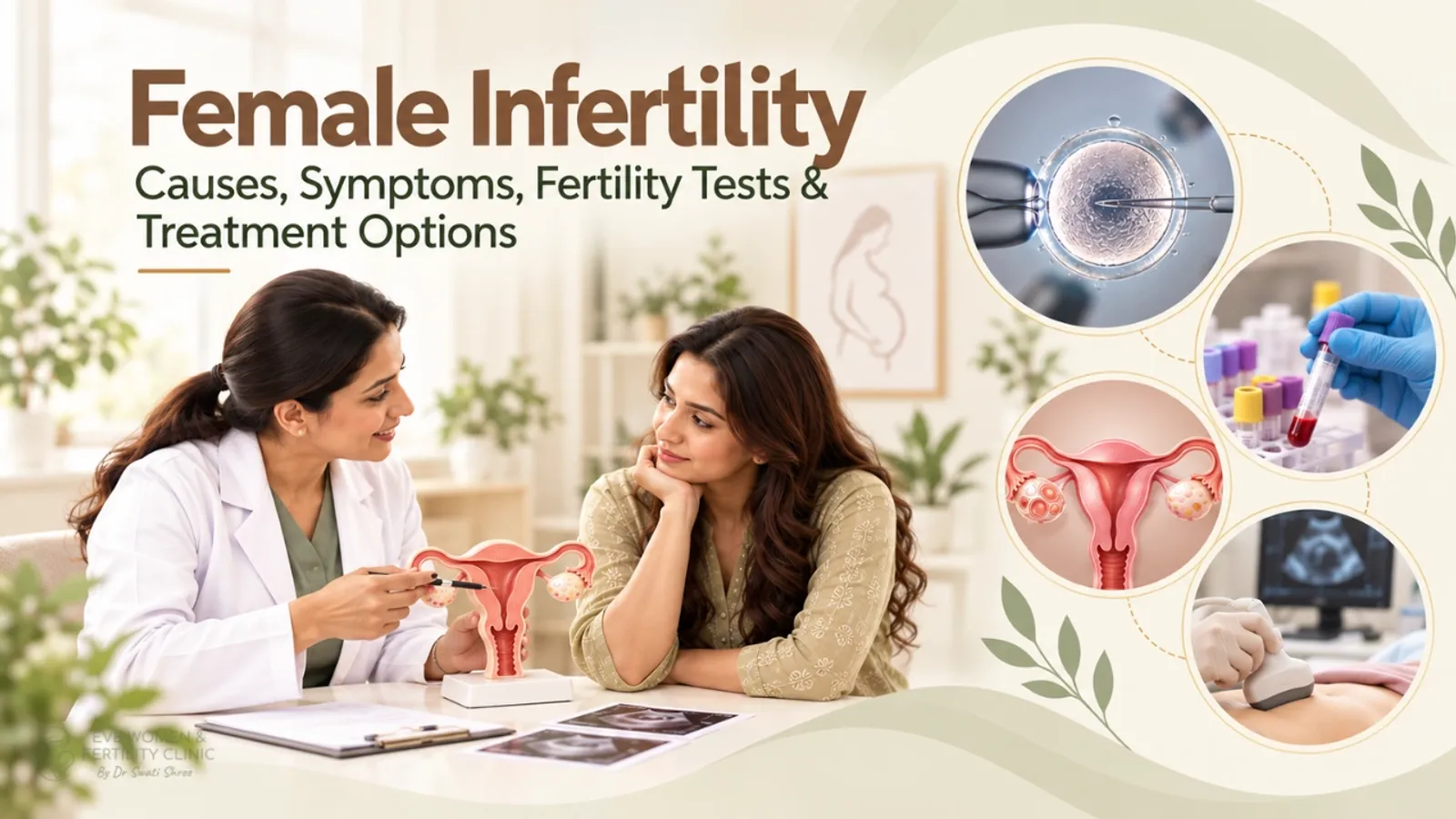
Quick answer: The usual reasons a woman struggles to conceive are irregular or absent ovulation, blocked or damaged fallopian tubes, problems inside the uterus, endometriosis, and the fall in egg numbers and quality that comes with age. For some couples, tests come back normal and no single reason is found. Testing typically starts with a consultation, hormone blood tests including AMH, a transvaginal ultrasound and a check of the tubes. The husband or partner should get a semen analysis at the same time. Treatment depends on what the tests show. It might be thyroid medicine, tablets to help you ovulate, IUI, a small surgical procedure, or IVF.
Female infertility is when a woman doesn't get pregnant after a year of regular, unprotected sex. If she is 35 or older, doctors shorten that to six months. In most cases the cause can be found with a handful of simple tests, and a good number of those causes respond to treatment.
It's more common than most people think. The World Health Organization estimates that about 1 in 6 people of reproductive age will face infertility at some point. In India, where relatives start asking about "good news" a few months after the wedding, that number rarely gets talked about.
Below you'll find what causes infertility in women, which symptoms deserve attention, how doctors test for it, and what treatment usually involves.
What counts as female infertility?
Doctors use time and age to decide when to start investigating. If you're under 35, the usual advice is to see a doctor after 12 months of trying. Between 35 and 40, that drops to six months. Over 40, most specialists would rather see you right away.
"Trying" here means having sex every two or three days through the month, without contraception. Couples who live apart for work or travel a lot may not have really been trying for as long as the calendar suggests, and that's worth mentioning to your doctor.
Primary and secondary infertility
Primary infertility means you have never been pregnant. Secondary infertility means you've been pregnant before, whether that pregnancy ended in a birth or not, and now it isn't happening again.
Secondary infertility catches a lot of couples off guard. Having a child already doesn't protect against problems later. Age, a new infection, a caesarean section, weight gain or a thyroid problem that wasn't there before can all change things.
Is it always the woman's problem?
No, and this belief causes real harm in Indian families. Infertility can sit with the woman, the man, both of them, or neither in any way tests can detect. Problems with sperm play a part for a large share of couples.
That's why a proper evaluation includes both partners from the first visit. A semen test is quick and painless. Skipping it can mean months of scans and medicines for the woman that were never going to solve the problem.
Why it helps to get checked sooner
Women are born with every egg they will ever have. The number goes down every year, and so does the quality, with the change becoming more noticeable after the mid thirties.
A lot of fertility problems are simple to pick up. Thyroid imbalance, high prolactin and PCOS-related ovulation problems usually show up on basic blood tests and a scan. Waiting two or three years in the hope that things will settle can use up time that would have been more useful earlier.
Seeing a specialist doesn't commit you to IVF. Quite often the first appointment ends with a clearer picture and a small next step, like better timing or a course of medicine.
What causes infertility in women?
Doctors sort the causes into a few broad groups. It's common to have more than one.
| Cause | What goes wrong | Examples |
|---|---|---|
| Ovulation problems | Eggs are released irregularly, or not at all | PCOS, thyroid disorders, high prolactin, being very underweight or overweight |
| Tubal problems | Egg and sperm can't meet | Old pelvic infection, genital TB, past surgery, endometriosis |
| Uterine problems | An embryo may find it harder to implant | Fibroids, polyps, a uterine septum, scar tissue |
| Endometriosis | Inflammation and scarring around the pelvic organs | Painful periods, ovarian cysts called endometriomas |
| Age and ovarian reserve | Fewer eggs, and lower egg quality | Low AMH, age over 35, early menopause |
| Unexplained | Standard tests are normal | Good reports, but no pregnancy |
Ovulation problems
If no egg is released in a cycle, pregnancy can't happen that month. Irregular ovulation is one of the most frequent reasons women come for a fertility consultation.
PCOS, or polycystic ovary syndrome, is the condition most people have heard of. Hormone levels shift in a way that makes ovulation unpredictable. Periods may come every 40 or 60 days, or skip months altogether. Some women also notice acne, extra hair on the face or body, or weight that's hard to shift, though plenty of women with PCOS have none of these. PCOS doesn't mean you can't have a baby. A lot of women with PCOS get pregnant, some on their own and some with a little help to ovulate.
Thyroid problems are common among Indian women and can upset the cycle whether the thyroid is underactive or overactive. They're usually easy to treat once found.
High prolactin, a hormone normally linked to breastfeeding, can switch off ovulation. A milky discharge from the breasts outside of breastfeeding is sometimes the clue.
Ovulation can also stop when the brain cuts back the hormone signals that drive it. This tends to happen with very low body weight, heavy training or severe ongoing stress. And in a small group of women, the ovaries stop working normally before 40. This is called premature ovarian insufficiency, and periods often become patchy or stop.
Tubal problems
The egg travels from the ovary down the fallopian tube, and that's normally where sperm meets it. If both tubes are blocked or badly damaged, fertilisation can't take place.
Pelvic infection is the most common reason. Chlamydia and gonorrhoea can damage the tubes quietly, sometimes years before anyone tries for a baby. In India, genital tuberculosis is another important cause, and it often gives no obvious symptoms. Previous abdominal or pelvic surgery, a burst appendix, an earlier ectopic pregnancy and endometriosis can also leave the tubes scarred.
Most women with blocked tubes feel nothing unusual. That's the reason a tube test is part of a routine work-up rather than something saved for later.
Problems inside the uterus
An embryo needs a healthy lining and a cavity of fairly normal shape to settle in.
Fibroids are non-cancerous lumps of muscle, and they're very common. The ones that push into the cavity, called submucosal fibroids, are the type most likely to get in the way. Fibroids in the outer wall often don't affect fertility at all.
Polyps are small growths of the lining. A septum is a band of tissue, present from birth, that divides the cavity. Scar tissue inside the uterus (Asherman syndrome) can form after infection or repeated procedures, and very light periods after a past D&C can be a hint that it's there. Adenomyosis, where the lining grows into the muscle wall, tends to cause heavy and painful periods.
Endometriosis
In endometriosis, tissue similar to the lining of the uterus grows outside it, usually on the ovaries, the tubes and the walls of the pelvis. It can cause inflammation, scarring and cysts on the ovary called endometriomas.
Plenty of women with endometriosis conceive without treatment. In others it affects how the tubes work, the quality of the eggs or the number left in the ovaries, which is why it needs careful assessment rather than a blanket answer.
Age and ovarian reserve
Ovarian reserve is the number of eggs remaining. It falls naturally with age. Egg quality drops too, and older eggs are more likely to carry chromosomal errors, which partly explains why miscarriage becomes more common later on.
A low AMH result tells you the reserve is smaller than average for your age. It doesn't mean pregnancy is impossible. AMH is better at predicting how your ovaries will respond to fertility drugs than at predicting whether you'll conceive naturally.
Unexplained infertility
Sometimes everything checks out. Hormones fine, tubes open, scan normal, semen report normal. And still no pregnancy.
Doctors call this unexplained infertility. It doesn't mean there's nothing wrong, only that whatever is going on is too subtle for routine tests to see. Couples in this group often do well with ovulation induction and IUI, and IVF is an option if that doesn't work.
Lifestyle factors
Weight at either extreme, smoking (including passive smoke at home), heavy drinking, poorly controlled diabetes and some medicines can all lower fertility. So can past chemotherapy or radiation. These are rarely the whole story, and none of them is a reason to blame yourself.
What are the signs of female infertility?
For most women, the only sign is that pregnancy isn't happening. You can feel completely healthy and still have a blocked tube or low reserve.
Some symptoms do point towards a condition worth checking. Cycles shorter than 21 days or longer than 35 days, periods that don't come for months, or periods that have become more painful year after year are all worth mentioning. So is deep pain during sex, very heavy bleeding, bleeding between periods, or periods that became very light after a uterine procedure.
Excess facial hair, persistent acne and sudden weight gain can go along with PCOS. A milky breast discharge when you aren't breastfeeding may mean high prolactin. Hot flushes or periods stopping before 40 can suggest the ovaries are winding down early.
Your history matters too. A past pelvic infection, TB, abdominal surgery, or two or more miscarriages are good reasons to see a specialist early.
None of these on its own means you're infertile. They just mean it's sensible not to wait.
How do doctors diagnose female infertility?
Testing happens in stages, and not everyone needs every test. Your doctor will pick what's useful based on your age, your history and anything already done.
The first appointment
Most of the first visit is talking. Expect questions about how long you've been trying and how often you have sex, what your periods are like, any earlier pregnancies, miscarriages or terminations, past infections or operations, medicines and supplements, your work hours, and your partner's health.
Bring every old report you have, including ones that seemed unimportant at the time. They often save a repeat test.
Fertility tests for women
| Test | What it tells you | Usual timing |
|---|---|---|
| FSH, LH and estradiol | How the hormones controlling the ovaries are working | Day 2 to 5 of the cycle |
| AMH | An estimate of how many eggs remain | Any day |
| TSH | Thyroid function | Any day |
| Prolactin | Whether prolactin is raised | Any day, usually in the morning |
| Progesterone | Whether ovulation took place | About a week before your period is due |
| Transvaginal ultrasound and antral follicle count | Uterus, ovaries, fibroids, cysts and egg reserve | Early in the cycle |
| HSG or HyCoSy | Whether the tubes are open, and the shape of the uterus | After bleeding stops, before ovulation |
| Follicular study | Follicle growth and the timing of ovulation | Several scans across one cycle |
Blood sugar, haemoglobin, rubella immunity and infection screening are often added as part of planning for pregnancy.
Making sense of the main tests
AMH is a hormone released by the small follicles in your ovaries. Higher levels generally mean more eggs in reserve. It says nothing about egg quality, and it can't tell you when menopause will arrive.
A transvaginal ultrasound uses a slim probe placed in the vagina. It gives a much clearer view than a scan over the tummy and can show fibroids, polyps, cysts and the typical ovary pattern of PCOS. The sonographer also counts the small resting follicles, which is another way of estimating reserve.
For an HSG, a dye is passed gently through the cervix while X-ray pictures are taken. If the dye spills out of the ends of the tubes, they're open. Most women get some cramping that settles within a short while. HyCoSy is a similar test done with ultrasound instead of X-ray.
A follicular study is a series of scans, usually a couple of days apart, to watch the egg follicle grow. Many patients in Bangalore know it simply as "follicular monitoring." It confirms whether you're ovulating and helps time intercourse or IUI.
When more tests are needed
If the first round raises questions, your doctor might suggest a hysteroscopy, where a thin camera looks inside the uterus. Polyps, a septum or scar tissue can often be dealt with during the same procedure. A laparoscopy, which is keyhole surgery under anaesthesia, may be recommended when endometriosis or pelvic scarring is suspected. Women who have had repeated miscarriages may need genetic tests and blood tests for clotting conditions such as antiphospholipid syndrome.
Testing your partner
A semen analysis looks at how many sperm there are, how well they move and their shape. One abnormal result is often repeated after a few weeks, since sperm counts can vary from sample to sample. Many men feel awkward about this test. It's routine, and it's one of the most useful tests a couple can do.
How is female infertility treated?
The plan depends on the cause, your age, how long you've been trying and your partner's report. Usually doctors start with the simplest option that has a fair chance of working, and step up if needed.
Treating what's underneath
Sometimes one correction is enough. Bringing thyroid levels back into range, lowering prolactin or getting diabetes under control can allow regular ovulation to return in some women.
Weight, food and habits
For women with PCOS who are carrying extra weight, even losing a modest amount can make periods more regular and help ovulation. Women who are underweight may find ovulation returns once they gain a little. Both partners benefit from giving up smoking.
Medicines to help you ovulate
Ovulation induction uses medicine to help the ovaries release an egg. Letrozole and clomiphene are tablets commonly used for this. Some women need injectable hormones called gonadotropins.
These should only be taken with a doctor's supervision and follicle scans. Taken blindly, they can cause twins or triplets, or simply not work while you lose months. Please don't start, stop or change fertility medicines on your own.
IUI
In IUI, or intrauterine insemination, your partner's semen sample is washed and concentrated in the lab. Around the time you ovulate, it's placed inside the uterus through a thin, soft tube. It takes a few minutes and feels much like a Pap smear.
IUI is often suggested for mild sperm problems, ovulation problems alongside ovulation induction, unexplained infertility, mild endometriosis, or when intercourse itself is difficult. At least one tube needs to be open and the sperm count reasonable for it to have a fair chance.
Surgery
Surgery helps when something structural is in the way. That might be removing polyps or a septum through hysteroscopy, taking out certain fibroids, treating endometriosis, or freeing adhesions. Not every fibroid or cyst needs to come out, and surgery on the ovaries can reduce egg reserve, so your doctor will weigh the likely gain against the risk.
IVF and ICSI
During IVF, injections stimulate the ovaries to grow several eggs. These are collected under sedation and mixed with sperm in a lab. A few days later, an embryo is placed into the uterus. ICSI is a variation where a single sperm is injected into each egg, often used when sperm numbers or movement are low.
IVF is usually considered for blocked tubes, severe endometriosis, low ovarian reserve, significant male factor, unexplained infertility after simpler treatment hasn't worked, or when age makes time a bigger concern.
At EVE Women and Fertility Clinic in Gunjur, Dr. Swati Shree can carry out your evaluation, plan treatment and guide your IVF through her partner centres in Bangalore, Apollo Fertility and Motherhood Fertility, where she is a visiting consultant.
Donor eggs and egg freezing
For women with very low reserve or premature ovarian insufficiency, donor eggs may come up in discussion. In India this falls under the ART (Regulation) Act, 2021, and eligibility rules apply, so it's best talked through in detail with your specialist.
Egg freezing lets some women keep the option of pregnancy for later, for example before cancer treatment. It works better at younger ages and can't promise a future pregnancy.
IUI and IVF compared
| IUI | IVF | |
|---|---|---|
| Where fertilisation happens | Inside the body | In the lab |
| Fallopian tubes | At least one must be open | Not required |
| Medicines | Tablets or low-dose injections | Daily injections during stimulation |
| Procedure | Short, no anaesthesia | Egg collection under sedation, then embryo transfer |
| Often considered for | Milder problems, earlier in treatment | Blocked tubes, severe male factor, low reserve, after IUI cycles that didn't work |
What does a fertility work-up look like in practice?
For most couples it goes something like this. You meet the doctor together and go through your history. Early in your next cycle, around day 2 to 5, you have blood tests and a scan. Your partner gives a semen sample. Once your period finishes, the tubes are checked with an HSG or HyCoSy. Later that cycle, a progesterone test or a few follicle scans show whether you ovulated.
Then you sit down with the results and talk about what they mean and what to do next. That could be timed intercourse, ovulation tablets, IUI, a procedure, or a referral pathway towards IVF.
The basic tests can usually be finished within one or two cycles.
Food, exercise and looking after yourself
There isn't a single food that makes you fertile, and there isn't one that ruins your chances either. An ordinary balanced Indian diet works well. Dal, rajma and chana, seasonal vegetables and fruit, curd, a handful of nuts, and whole grains like ragi, jowar, brown rice or whole wheat rotis.
If you have PCOS, cutting back on mithai, sugary drinks, bakery snacks and large helpings of white rice tends to help, along with a bit more protein at each meal. Small changes you can keep up beat a strict diet you drop after three weeks.
Folic acid is generally advised for anyone trying to conceive. Your doctor can suggest the right one.
Moderate exercise like brisk walking, yoga or swimming helps with weight and insulin. Extreme training on very little food can do the opposite. Sleep matters too, and that's hard for couples in Whitefield or Sarjapur Road dealing with long commutes, late calls and night shifts. Do what's realistic.
The emotional side gets less attention than it should. The monthly wait, the disappointment, the questions at family functions, the unasked-for advice. It wears people down. Stress on its own is rarely what causes infertility, so working long hours or feeling anxious doesn't mean you did this. Talking honestly with your partner, deciding together how much to share with family, and seeing a counsellor if things feel heavy can all make the months easier.
Risks and limits of treatment
Supervised fertility treatment is generally safe, but it isn't free of risk.
Ovulation medicines and IVF raise the chance of twins or more, and multiple pregnancies carry more risk for both mother and babies. Regular scans help keep that risk down.
Some women over-respond to injectable hormones and develop ovarian hyperstimulation syndrome, or OHSS. Mild OHSS feels like bloating and discomfort. Severe OHSS is uncommon but needs urgent care.
A pregnancy can also implant outside the uterus, usually in a tube. Women with tubal damage have a higher chance of this ectopic pregnancy.
Tests like HSG and hysteroscopy, and egg collection in IVF, can leave you with cramps or spotting for a day or two.
And no treatment can promise a baby. Treatment raises the odds, and how much depends on age, diagnosis, egg reserve, sperm quality and other individual factors.
Myths worth letting go of
The idea that infertility is the woman's fault is probably the most damaging one. Male factors are common, and both partners need testing.
Many women hear that PCOS means they'll never conceive. Most women with PCOS who want a baby can get pregnant, often with fairly simple help to ovulate.
Low AMH gets treated like a final verdict. It means fewer eggs, and women with low AMH do get pregnant.
Regular periods are reassuring, but they don't rule out blocked tubes, endometriosis or a sperm problem.
"Just relax and it'll happen" is well meant. Relaxing won't open a tube or fix a thyroid, though.
Some families worry that IVF babies aren't "normal." The vast majority of children born through IVF are healthy, and the treatment has been used and studied for decades.
Probably the costliest mistake is spending years on herbal mixtures and wait-and-see advice, especially after 35, when time is worth more.
Questions you might want to ask your doctor
- Which tests do we both need, and what will each one tell us?
- What do my AMH and scan results mean at my age?
- Are my tubes open, and am I ovulating?
- Have you found a cause, or does this look unexplained?
- What would you try first, and how long before we change the plan?
- Which side effects or warning signs should I watch for?
- If we need IVF, how does that work and where is it done?
- Is there anything we can do at home that actually helps?
When should you see a fertility specialist?
Book an appointment if you're under 35 and have been trying for a year, if you're between 35 and 40 and it's been six months, or if you're over 40 and want to conceive. Don't wait the full time if your periods are very irregular or have stopped, if you already know you have PCOS, endometriosis, fibroids or a thyroid problem, if you've had pelvic infection, TB or pelvic surgery, if you've had two or more miscarriages, or if your partner has a known sperm problem or hasn't been tested yet.
For women in Gunjur, Varthur, Whitefield, Sarjapur Road and the rest of East Bangalore, having a fertility specialist close by makes the repeated scans and follow-up visits much easier to fit around work.
Get urgent help if you notice
- Severe tummy pain, swelling, breathlessness or passing very little urine after fertility injections, which can mean OHSS
- Pain on one side of the pelvis, pain in the shoulder tip, dizziness, fainting or bleeding in early pregnancy, which can mean an ectopic pregnancy
- Heavy bleeding during pregnancy
- Fever, a bad-smelling discharge or severe pain after any procedure
- Severe pelvic pain with fever, which may be an infection
Key Takeaways
- Infertility is diagnosed after 12 months of trying, or 6 months if you're 35 or older.
- Ovulation problems, blocked tubes, uterine conditions, endometriosis and age-related changes in egg reserve are the most common causes.
- Many women have no symptoms, so tests tell you more than waiting does.
- A basic work-up covers hormones, AMH, an ultrasound, a tube test and a semen analysis.
- Treatment can range from thyroid medicine or ovulation tablets to IUI, surgery or IVF.
- Both partners should be tested together from the beginning.
- Earlier assessment usually means more options, especially after 35.
- Treatment improves the chance of pregnancy but can't guarantee it.
Final Thoughts
- Medical Disclaimer
- This article is for educational purposes only and does not replace professional medical advice. Fertility treatment outcomes vary from person to person. Please consult a qualified doctor for diagnosis and treatment.
For a lot of women, the hardest part isn't the tests or the treatment. It's not knowing why. A careful evaluation usually turns that into specific answers and a plan you can act on.
Some couples need very little, perhaps a thyroid tablet or better timing. Others need more. Whichever group you fall into, you should get honest information, be treated with respect, and have room to make decisions at your own pace.
If you've been trying for a while and have questions, you can book a fertility consultation with Dr. Swati Shree at EVE Women and Fertility Clinic, Gunjur, Bangalore. She can go through your history and reports with you, suggest the tests that make sense, and talk through treatment options that fit your situation.
More in this series
FAQs
What is the most common cause of female infertility?
Problems with ovulation are among the most frequent causes, and PCOS is a leading reason ovulation becomes irregular. Blocked fallopian tubes, endometriosis, fibroids or polyps in the uterus, and the drop in egg reserve that comes with age are also common. Many couples have more than one factor, and sperm problems often play a part too, so both partners should be tested.
Can a woman with regular periods still be infertile?
Yes. Regular periods usually mean you're ovulating, which is a good sign, but they don't rule everything out. Blocked tubes, endometriosis, polyps, low ovarian reserve or a sperm problem in your partner can all exist alongside a perfectly regular cycle. If pregnancy hasn't happened in the expected time, testing is still worth doing.
Which tests are used to check female fertility?
Most evaluations include blood tests for FSH, LH, estradiol, thyroid and prolactin, plus an AMH test to estimate egg reserve. A transvaginal ultrasound looks at the uterus and ovaries, and an HSG or HyCoSy checks whether the tubes are open. A follicular study or progesterone test confirms ovulation. The male partner should have a semen analysis alongside these.
Can female infertility be treated?
Often, yes. Thyroid and prolactin problems usually respond to medicine, ovulation can be helped with tablets or injections, and some uterine problems can be corrected with a short procedure. IUI and IVF are options when simpler steps aren't enough. Treatment improves the chance of pregnancy, though results depend on age, diagnosis and other personal factors.
How long should we try before seeing a fertility doctor?
The general advice is 12 months of regular unprotected sex if you're under 35, and six months if you're between 35 and 40. Over 40, it's sensible to see a doctor straight away. Go sooner if your periods are irregular, you have PCOS or endometriosis, you've had a pelvic infection, or you've had repeated miscarriages. Twelve months of regular unprotected intercourse under 35, or six months at 35 and above. Come earlier with irregular periods, severe pain, known conditions or a history of pelvic infection.
Does low AMH mean I can't get pregnant?
No. Low AMH means your ovaries hold fewer eggs than average for your age. It doesn't measure egg quality and doesn't rule out pregnancy, and many women with low AMH conceive either naturally or with treatment. Doctors mainly use AMH to judge how your ovaries may respond to fertility medicines and how soon to start treatment.
Where can I get a fertility consultation in East Bangalore?
If you live in Gunjur, Varthur, Whitefield, Sarjapur Road or nearby, you can see Dr. Swati Shree at EVE Women and Fertility Clinic in Gunjur. The clinic provides fertility assessment, counselling, ovulation induction, follicle monitoring and IUI. When IVF is needed, Dr. Swati Shree guides treatment through her partner fertility centres in Bangalore.
Can stress cause infertility in women?
Stress by itself is rarely the main cause, and feeling anxious doesn't mean you caused the problem. Severe stress combined with very low food intake or intense exercise can sometimes disturb ovulation. More often it works the other way round, with infertility causing the stress. Counselling, rest and honest conversations with your partner can make treatment easier to get through.