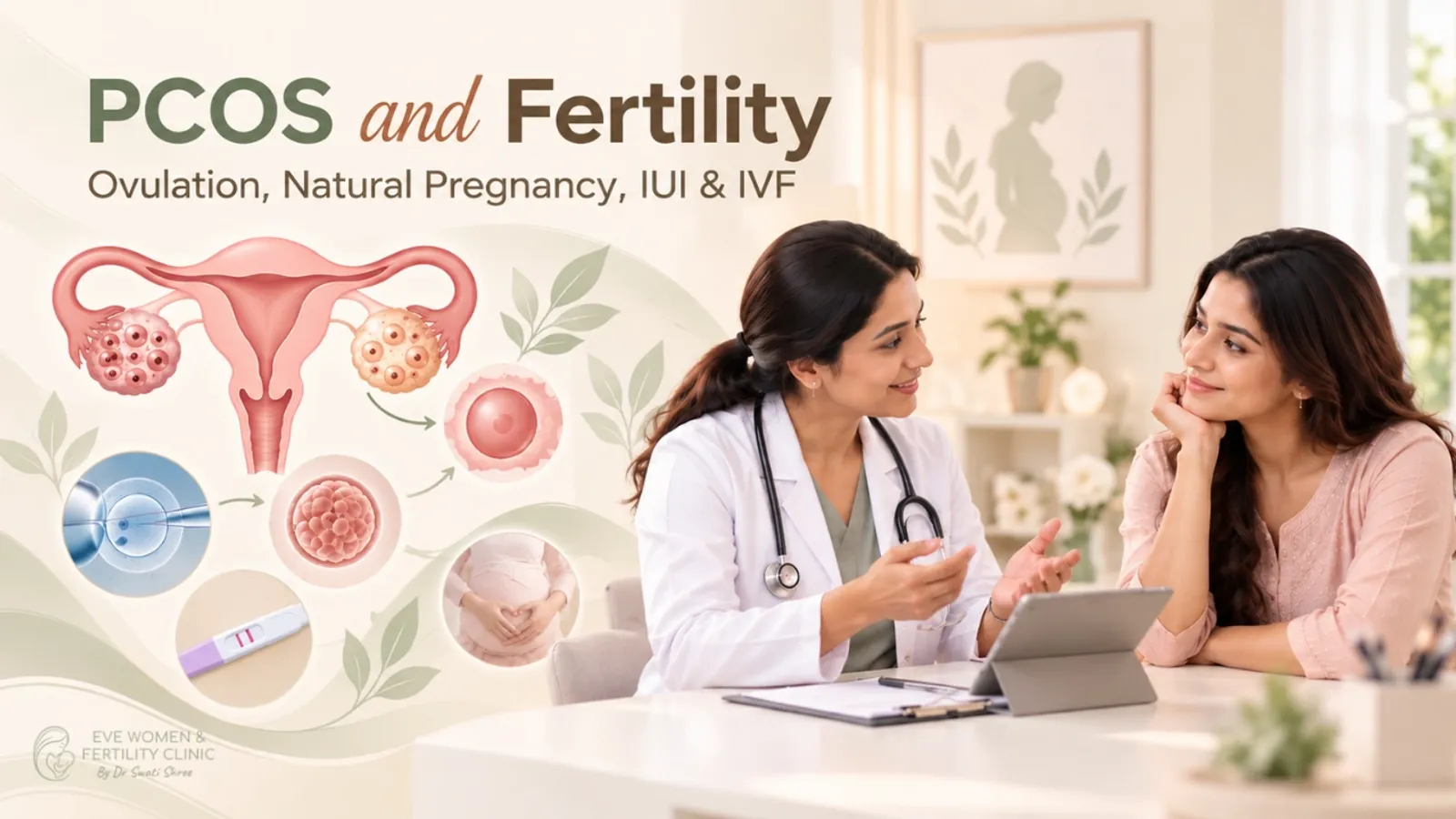
PCOS and Fertility: Ovulation, Natural Pregnancy, IUI & IVF
Can you get pregnant with PCOS?
Yes. PCOS does not mean that you cannot become pregnant. The main difficulty for many women with PCOS is irregular ovulation. If an egg is not released regularly, there are fewer opportunities for conception and it can become difficult to predict the fertile days.
Some women with PCOS conceive naturally. Others may need help with ovulation treatment, IUI or IVF. Which option makes sense depends on more than the PCOS diagnosis. Age, sperm health, fallopian tubes, ovarian reserve, previous pregnancies and how often ovulation occurs all have a role.
That is why PCOS-related fertility care starts with understanding what is actually happening in your reproductive system rather than assuming that IVF is necessary.
How does PCOS affect fertility?
PCOS is a hormonal condition that can affect ovulation, menstrual cycles and androgen levels. Not every woman with PCOS has the same symptoms, and the effect on fertility varies considerably.
For some women, periods may come every 35 to 60 days. Others may go several months without a period. Some women have relatively regular cycles despite having PCOS.
The fertility concern is usually related to ovulation.
During a normal ovulatory cycle, a follicle develops in the ovary and eventually releases an egg. If ovulation happens infrequently, conception becomes less predictable.
This does not mean the ovaries have stopped working.
It means that the process of developing and releasing an egg may not be happening regularly.
Does having periods mean that you are ovulating?
Not always.
Menstrual bleeding and ovulation are related, but they are not the same thing. A woman can have bleeding without having regular ovulation.
This is particularly relevant when periods are very irregular.
If you have PCOS and your cycles are unpredictable, a fertility specialist can assess whether you are ovulating and whether anything else may be affecting conception.
Can you conceive naturally with PCOS?
Yes. Many women with PCOS become pregnant without IVF.
If you are ovulating and there are no significant problems involving the fallopian tubes or sperm, natural conception may be possible.
The difficulty is often knowing when ovulation is happening.
For someone with a 28-day cycle, estimating the fertile period may be relatively straightforward. With PCOS, a cycle can be much longer or change from month to month. That makes calendar-based fertility tracking less reliable.
Ovulation-prediction kits can also be difficult to interpret in some women with PCOS because hormone patterns may affect the test result.
If you are trying to conceive, regular intercourse throughout the cycle may be more practical than relying entirely on one predicted ovulation day.
If periods are very infrequent, however, it is worth discussing the situation with a fertility specialist rather than simply waiting indefinitely.
How long should you try naturally with PCOS?
There is no single answer for every woman.
Age and menstrual history matter.
For women younger than 35 without known fertility problems, infertility evaluation is generally considered after 12 months of trying. At 35 or older, evaluation is generally recommended after 6 months. Earlier assessment may be appropriate when there is already a known or suspected fertility problem.
PCOS with very irregular or absent periods is one reason not to rely only on a standard "wait for a year" approach.
If you are rarely getting periods, you may also be ovulating rarely. Finding out why can save months of uncertainty.
A PCOS diagnosis does not automatically explain every case of delayed pregnancy.
A proper fertility assessment looks at both partners and considers several parts of reproduction.
Ovulation
Your doctor may review your cycle pattern and use blood tests or ultrasound when appropriate.
If treatment is started, follicular monitoring can show how the ovary is responding.
Fallopian tubes
The fallopian tubes need to be open for sperm and egg to meet naturally.
Depending on your history and treatment plan, your doctor may recommend a test such as an HSG or another assessment of tubal patency.
Semen analysis
A man's fertility matters too.
If pregnancy is not occurring, checking the semen analysis can provide important information about sperm count, movement and morphology.
Treating ovulation without identifying a significant male-factor problem can delay appropriate care.
Ovarian reserve
Tests such as AMH and antral follicle count can provide information about ovarian reserve.
But ovarian reserve and fertility are not interchangeable terms.
A low or high AMH result by itself does not tell you whether you will or will not become pregnant naturally.
When PCOS is causing anovulatory infertility and there are no other infertility factors, treatment often begins by helping the ovary ovulate.
This is called ovulation induction.
The international PCOS guideline recommends letrozole as the preferred first-line pharmacological treatment for ovulation induction in women with PCOS who are not ovulating and have no other infertility factors.
The treatment is not something to start on your own. The choice of medicine, dose and monitoring depends on your medical history and fertility assessment.
How does ovulation induction work?
- The basic aim is simple
- help a follicle develop and release an egg.
- A treatment cycle may involve
- Starting medication at the prescribed time.
- Monitoring follicle development when required.
- Identifying the likely time of ovulation.
- Timing intercourse or IUI appropriately.
- Assessing the result of the cycle.
The exact protocol varies between patients.
Some women respond well to treatment. Others may need a change in the approach after reviewing how their ovaries responded.
What is a follicular study?
- It can help the doctor see
- A sustainable routine can include
- A typical IUI cycle may involve
- The doctor may look at
- Age should therefore be considered alongside
- It is
A follicular study is a series of ultrasound examinations used to follow the development of ovarian follicles during a menstrual cycle.
- Whether a follicle is developing
- How it is growing
- Whether ovulation appears likely
- How the ovaries are responding to medication
- When intercourse or IUI should be timed
For women with PCOS, this can be useful because ovulation may not follow a predictable calendar.
A follicular study does not guarantee pregnancy. Its purpose is to give the fertility team better information when making treatment decisions.
Lifestyle is part of PCOS care, but it should not become a source of blame.
There is no single diet that works for every woman with PCOS, and fertility problems are not caused simply by a lack of willpower.
- Regular physical activity
- A balanced diet
- Adequate sleep
- Attention to blood sugar and metabolic health
- Avoiding smoking
- Limiting alcohol where relevant
- Reviewing medicines before pregnancy
- Appropriate preconception care
Indian meals can still fit into a healthy eating pattern.
There is no requirement to completely remove rice, dal, roti or other familiar foods. What matters is the overall dietary pattern, portion balance, protein and fibre intake, and whether the approach can realistically be maintained.
If weight is affecting metabolic health, your doctor may discuss gradual changes. That conversation should be about health, not shame.
Women with PCOS can have fertility problems at different body weights, so weight alone should never be used to explain infertility.
IUI stands for intrauterine insemination.
During IUI, sperm is prepared in the laboratory and then placed directly into the uterus around the time of ovulation.
For a woman with PCOS, IUI may be considered when ovulation has been induced or is being monitored and the other fertility factors are suitable.
- Ovulation assessment or induction
- Follicular monitoring
- Timing of ovulation
- Semen collection
- Laboratory preparation of the sperm
- Placement of the prepared sperm into the uterus
- Pregnancy testing at the appropriate time
The sperm still has to fertilise the egg inside the reproductive tract.
IUI is therefore different from IVF.
| IUI | IVF |
|---|---|
| Prepared sperm is placed inside the uterus | Eggs are retrieved and fertilised outside the body |
| Fertilisation occurs inside the reproductive tract | Fertilisation occurs in the laboratory |
| Usually involves a less complex treatment process | Requires ovarian stimulation, egg retrieval and laboratory procedures |
| May be considered in selected fertility situations | May be considered when other treatment is unsuitable or unsuccessful, or another indication exists |
| Does not involve embryo creation in a laboratory | Embryos are created and subsequently transferred according to the treatment plan |
The choice should be based on the individual fertility assessment rather than the PCOS diagnosis alone.
No.
If ovulation can be achieved and there are no other major fertility problems, timed intercourse may be appropriate in some cases.
IUI becomes a consideration when the clinical situation makes it useful.
- Age
- Duration of infertility
- Ovulation
- Sperm parameters
- Fallopian-tube status
- Previous treatment
- Other fertility conditions
There is no universal number of IUI cycles that is right for everyone.
IVF is not automatically the next step after a PCOS diagnosis.
For women with PCOS who have anovulatory infertility and no other major infertility factors, IVF may be considered if first- or second-line ovulation treatments have not resulted in pregnancy.
IVF may also enter the discussion earlier when another fertility factor is present.
For example, the treatment plan may be different if there is:
- Significant tubal disease
- A substantial male-factor fertility problem
- Another reproductive condition affecting conception
- Previous unsuccessful fertility treatment
- A clinical reason that makes IVF more appropriate
The decision is made after looking at the whole fertility picture.
The basic IVF process includes several stages.
1. Fertility assessment
Before treatment, the fertility team reviews the medical history, ovarian reserve, ultrasound findings, semen analysis and other relevant information.
2. Ovarian stimulation
Medicines are used to stimulate the ovaries so that several follicles can develop.
Women with PCOS may respond strongly to ovarian stimulation, so careful monitoring is important.
3. Monitoring
Ultrasound and, when appropriate, blood tests are used to assess the ovarian response.
4. Egg retrieval
When the follicles are ready, the eggs are retrieved using a medical procedure.
5. Fertilisation
The eggs are fertilised with sperm in an IVF laboratory. Conventional IVF or ICSI may be considered depending on the circumstances.
6. Embryo development
The resulting embryos are monitored in the laboratory.
7. Embryo transfer
An embryo may then be transferred into the uterus according to the treatment plan.
8. Pregnancy testing
The fertility team advises when pregnancy testing should be performed.
Women with PCOS also need to be counselled about ovarian hyperstimulation syndrome (OHSS). Treatment protocols can be adjusted to reduce this risk.
PCOS is associated with an increased risk of ovarian hyperstimulation because the ovaries may contain a large number of follicles and can respond strongly to stimulation medicines.
This does not mean that OHSS will happen.
Modern IVF treatment includes strategies designed to reduce the risk, and the stimulation protocol can be selected according to the woman's ovarian response.
After fertility treatment, severe abdominal swelling, significant abdominal pain, breathlessness or reduced urine output require prompt medical assessment.
PCOS does not stop being relevant once pregnancy occurs.
Women with PCOS have an increased risk of some pregnancy complications, including gestational diabetes and hypertensive disorders. This is one reason preconception care and appropriate pregnancy monitoring matter.
It is also important not to interpret this information as a prediction for an individual woman.
Having PCOS does not mean that a pregnancy will necessarily have complications.
Your obstetric team can assess your personal risk and decide what monitoring is appropriate.
Yes.
PCOS can interfere with ovulation, but it does not prevent the normal age-related changes in female fertility.
This distinction is easy to miss.
A 32-year-old woman with PCOS and irregular ovulation has a different fertility situation from a 39-year-old woman with PCOS, even if both have similar menstrual symptoms.
- Ovulation
- Ovarian reserve
- Sperm quality
- Tubal status
- Previous pregnancy history
- Duration of infertility
- Other reproductive conditions
For women in their 30s or 40s who are concerned about fertility timing, an early consultation can provide more useful information than waiting until pregnancy becomes urgent.
There is no specific age at which every woman with PCOS suddenly becomes infertile.
At the same time, fertility does decline with age, particularly because egg number and egg quality change over time.
If you are over 30 and planning pregnancy, the useful question is not simply "Do I have PCOS?"
How often am I ovulating, and are there any other factors that could affect conception?
That answer can be much more informative when planning treatment.
"PCOS means I cannot have a baby."
PCOS can make conception more difficult, particularly when ovulation is irregular. It does not mean pregnancy is impossible.
"If my periods come, I must be ovulating."
Not necessarily. Irregular bleeding does not always represent regular ovulation.
"Every woman with PCOS needs IVF."
No. Treatment may range from natural conception and ovulation induction to IUI or IVF, depending on the individual situation.
"PCOS is caused by being overweight."
PCOS is a complex hormonal and metabolic condition. Women with different body types can have PCOS.
"Only i need fertility testing because i have PCOS."
No. Fertility involves two partners, where applicable. A semen analysis can be an important part of the evaluation.
"If one treatment does not work, IVF is automatically the only option."
- You may want to ask
- A fertility consultation may be useful if
- Seek urgent medical advice if you develop
- Medical Disclaimer
- This article is for educational purposes only and does not replace professional medical advice. Fertility treatment outcomes vary from person to person. Please consult a qualified doctor for diagnosis and treatment.
Not necessarily. The next step depends on what happened during treatment and what the overall fertility evaluation shows.
A consultation is easier when you know what you want to understand.
- Am I ovulating?
- Do I need a follicular study?
- Should my partner have a semen analysis?
- Do my fallopian tubes need to be checked?
- Which ovulation treatment is suitable for me?
- Would timed intercourse be reasonable?
- Is IUI appropriate in my situation?
- What would make IVF necessary?
- How will my response to treatment be monitored?
- How does my age affect the plan?
There is no need to decide on IUI or IVF before the evaluation is complete.
- Your periods are very irregular or absent
- You have PCOS and have been trying to conceive without success
- You are younger than 35 and have been trying for 12 months
- You are 35 or older and have been trying for 6 months
- You are over 40 and want to discuss fertility planning
- You have a known tubal problem
- You have endometriosis or another reproductive condition
- Your partner has an abnormal semen analysis
- You have previously undergone fertility treatment
- You want to understand your options before delaying pregnancy further
With very irregular periods, it can be reasonable to seek advice sooner because irregular ovulation itself may be affecting your chances of conception.
Fertility treatment is generally closely monitored, but certain symptoms should not be ignored.
- Severe abdominal or pelvic pain
- Significant abdominal swelling
- Breathlessness
- A marked reduction in urine
- Heavy bleeding
- Fainting or severe dizziness
- One-sided pelvic pain during early pregnancy
- Shoulder-tip pain with early-pregnancy bleeding
- Fever following a procedure
These symptoms can sometimes occur with complications such as OHSS, ectopic pregnancy, bleeding or infection.
EVE Women and Fertility Clinic in Gunjur, Bangalore provides fertility assessment, counselling, ovulation induction, follicle monitoring and IUI within its documented ART Level 1 scope. Pasted text
For advanced ART procedures, the care pathway is different. Egg retrieval, IVF, ICSI, embryo culture, embryo freezing and embryo transfer are performed through EVE's partner facilities, Apollo Fertility and Motherhood Fertility, where Dr. Swati Shree is a visiting consultant. Pasted text
This distinction is worth understanding before treatment begins. A fertility plan can involve several stages, and those stages do not necessarily take place at the same facility.
- PCOS does not automatically mean infertility.
- Irregular or absent ovulation is one of the main ways PCOS can affect conception.
- Natural pregnancy is possible for many women with PCOS.
- Fertility evaluation should consider both partners.
- Letrozole is the recommended first-line pharmacological option for ovulation induction in women with PCOS-related anovulatory infertility when there are no other infertility factors.
- Follicular monitoring can help determine how the ovaries are responding to treatment.
- IUI may be appropriate for some couples.
- IVF is not automatically required because of PCOS.
- Age, sperm health, tubal status and other reproductive factors can change the treatment plan.
- Metabolic health and preconception care deserve attention before pregnancy.
- Treatment should be based on the individual fertility assessment, not on the PCOS label alone.
A PCOS diagnosis can make trying to conceive feel uncertain, especially when periods are unpredictable. But an irregular cycle does not tell the whole story.
The first useful step is to find out whether you are ovulating and whether anything else may be affecting conception.
For one woman, that may mean trying naturally. For another, ovulation induction and follicular monitoring may be enough. IUI can be considered in selected situations, while IVF may be appropriate when other treatments are unsuccessful or another fertility factor is present.
There is no single PCOS fertility treatment that applies to everyone.
If you are looking for fertility care in Gunjur or East Bangalore, you can discuss your cycle pattern, previous treatment and pregnancy plans with Dr. Swati Shree at EVE Women and Fertility Clinic, Gunjur, Bangalore.
More in this series
FAQs
Can I get pregnant naturally if I have PCOS?
Yes. PCOS does not automatically prevent natural pregnancy. The main difficulty is often irregular ovulation. If ovulation occurs and there are no significant problems involving the fallopian tubes, sperm or other reproductive factors, natural conception may be possible.
Which treatment is usually used first for PCOS-related ovulation problems?
For women with PCOS who are not ovulating and have no other infertility factors, letrozole is recommended as the first-line pharmacological treatment for ovulation induction. It should be prescribed and monitored by a qualified doctor. Letrozole is the usual first choice for ovulation induction in PCOS, given for five days early in the cycle with follicular scan monitoring. If it does not work, the dose or medicine is changed.
Does PCOS mean I need IVF?
No. IVF is not automatically required for PCOS. Depending on the fertility assessment, treatment may involve natural conception, ovulation induction or IUI. IVF may be considered when other treatment has not worked or another fertility factor makes it appropriate.
Is IUI useful for women with PCOS?
IUI can be considered in selected cases. The decision depends on factors such as ovulation, sperm quality, tubal status, age and previous treatment. During IUI, prepared sperm is placed into the uterus around the time of ovulation. It can be, once ovulation is reliably triggered and at least one tube is open and the semen report is reasonable. IUI is usually considered after a few ovulation-induction cycles have not led to pregnancy.
Can irregular periods mean I am not ovulating?
Yes. Very irregular or absent periods can indicate ovulatory dysfunction. However, the exact situation needs medical assessment. A fertility specialist may use menstrual history, blood tests or ultrasound to assess ovulation. Often, yes. Periods that come very late or unpredictably usually reflect irregular or absent ovulation. A mid-luteal progesterone blood test or follicular scans can confirm whether you actually ovulate.
Should my partner have a semen analysis if I have PCOS?
Yes, where applicable. Fertility problems can involve the woman, the man, both partners or sometimes no clearly identifiable factor. A semen analysis can help identify male-factor fertility problems before treatment is planned. Yes. Male factors contribute to roughly a third of fertility problems, so testing both partners from the start saves months of treating the wrong problem. A semen analysis is quick and inexpensive.
When should a woman with PCOS see a fertility specialist?
Earlier assessment may be useful when periods are very irregular or absent. In general, evaluation is considered after 12 months of trying for women under 35 and after 6 months for women aged 35 or older. Known fertility concerns may justify earlier evaluation.
Where can I get fertility care for PCOS in East Bangalore?
EVE Women and Fertility Clinic in Gunjur, Bangalore provides fertility assessment, ovulation induction, follicle monitoring and IUI within its documented ART Level 1 scope. Advanced IVF procedures are carried out through the clinic's documented partner fertility centres. Pasted text