
Pregnancy After IVF: What Happens After Embryo Transfer
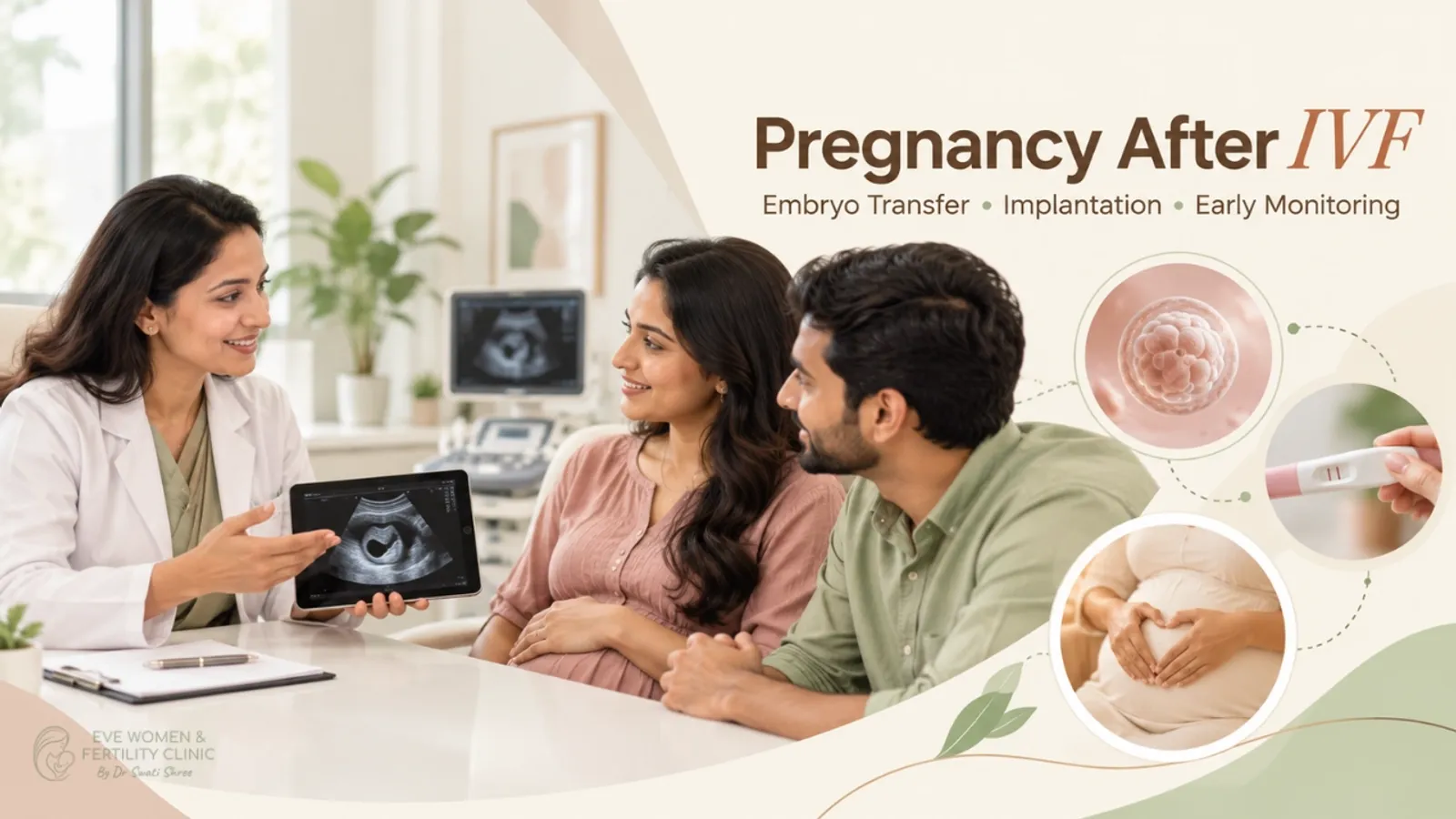
Quick answer: After IVF embryo transfer, the embryo may implant in the uterine lining and begin producing hCG. Your fertility clinic will tell you when to have the pregnancy test. If the result is positive, further hCG testing and an early ultrasound may be advised to assess how the pregnancy is developing and confirm that it is located inside the uterus. Heavy bleeding, severe abdominal or pelvic pain, fainting, shoulder-tip pain or severe breathlessness need prompt medical assessment.
Introduction
Getting a positive pregnancy test after IVF can feel very different from getting one after natural conception. There may be relief, excitement and, at the same time, a lot of questions. What happens next? When does implantation occur? Is cramping normal? When should hCG be checked? When will the pregnancy be visible on ultrasound?
After embryo transfer, the embryo needs to implant in the uterine lining for pregnancy to become established. Once implantation occurs, the developing pregnancy produces human chorionic gonadotropin, known as hCG. A blood pregnancy test can then detect this hormone. Early follow-up may include repeat hCG testing and an ultrasound at the appropriate stage of pregnancy.
The important thing to remember is that symptoms alone cannot tell you whether implantation has occurred or whether an early pregnancy is progressing normally. The timing of tests and scans matters.
After IVF embryo transfer, the embryo may implant in the uterine lining and begin producing hCG. Your fertility clinic will tell you when to have the pregnancy test. If the result is positive, further hCG testing and an early ultrasound may be advised to assess how the pregnancy is developing and confirm that it is located inside the uterus. Heavy bleeding, severe abdominal or pelvic pain, fainting, shoulder-tip pain or severe breathlessness need prompt medical assessment.
What happens after an IVF embryo transfer?
Embryo transfer is the procedure in which an embryo is placed into the uterus. It is an important part of IVF, but the transfer itself does not confirm pregnancy.
After the transfer, the embryo continues its development. If implantation takes place, the pregnancy begins producing hCG. This hormone eventually becomes detectable in the mother's blood.
There is therefore a period between embryo transfer and the pregnancy test.
That waiting period can be difficult. It is common to notice every small change in the body and wonder whether it means something. Unfortunately, most early symptoms are not specific enough to provide an answer.
Mild cramps, breast tenderness, tiredness or spotting can occur. Some women have no symptoms at all.
None of these findings can reliably confirm implantation.
What is implantation after IVF?
Implantation is the process in which an embryo attaches to and becomes established within the lining of the uterus.
The embryo transferred during IVF does not immediately become a pregnancy simply because it has been placed in the uterus. It has to continue developing and interact with the uterine lining.
Once implantation occurs, cells associated with the developing pregnancy start producing hCG.
This is the biological reason pregnancy testing cannot provide a useful answer immediately after embryo transfer.
Can You Feel Implantation?
There is no reliable physical sensation that tells you implantation has occurred.
Some women describe mild cramping or light spotting around this period. Others notice nothing.
Cramping and spotting can also have other causes, including the embryo transfer procedure itself, hormonal medicines or normal changes in the uterine lining.
So, if you do not feel anything, it does not mean implantation has not happened. If you experience cramps or spotting, it does not prove that it has happened.
The pregnancy test is far more useful than trying to interpret these sensations.
What is hCG after IVF?
Human chorionic gonadotropin, or hCG, is a hormone produced by pregnancy tissue after implantation.
A blood beta-hCG test measures this hormone and is commonly used to confirm an early pregnancy following IVF.
Your doctor may look at more than one result. A repeat test can show how the hCG level is changing over time.
The result needs to be interpreted in context. The date of embryo transfer, the timing of implantation, symptoms and later ultrasound findings all matter.
One hCG number cannot answer every question about an early pregnancy.
When is the pregnancy test done after IVF?
Your fertility clinic will give you a specific date for pregnancy testing.
Testing too soon after embryo transfer can cause confusion. The embryo may not yet have implanted, or hCG may not have reached a level that can be detected reliably.
There is another reason very early testing can sometimes be misleading. Some IVF protocols use an hCG-containing trigger injection. If a pregnancy test is taken too soon afterward, hCG remaining from the medication can contribute to a positive result.
For this reason, it is better to follow the testing date provided by your fertility team rather than repeatedly testing at home.
What happens after a positive IVF pregnancy test?
- Your doctor may recommend
A positive pregnancy test is an important milestone, but early follow-up still matters.
- A repeat blood hCG test
- Continued prescribed medicines
- An early pregnancy ultrasound
- Further ultrasound monitoring
- Review of any bleeding, pain or other symptoms
The early ultrasound is particularly important because it helps establish where the pregnancy is located and how it is developing.
Depending on the stage of pregnancy, the scan may show a gestational sac, yolk sac, embryo and, later, cardiac activity.
The exact timing matters. A scan performed too early may not show structures that become visible a few days later.
What is the early pregnancy timeline after IVF?
The sequence is broadly similar for many IVF pregnancies, although the timing can vary.
| Stage | What may happen |
|---|---|
| Embryo transfer | The embryo is placed in the uterus |
| After transfer | The embryo continues to develop |
| Implantation | The embryo attaches to the uterine lining |
| After implantation | hCG production begins |
| Pregnancy testing | Blood hCG is checked at the time advised by the clinic |
| Repeat hCG | May be recommended to assess the change over time |
| Early ultrasound | Pregnancy location and development are assessed |
| Further monitoring | Follow-up is planned according to the pregnancy and clinical findings |
Your own timeline may not match someone else's exactly. That is normal.
What symptoms can occur after embryo transfer?
- You may notice
The days after transfer can be confusing because IVF medicines can produce symptoms that feel similar to early pregnancy.
- Mild lower abdominal cramping
- Breast tenderness
- Bloating
- Fatigue
- Mild spotting
- Increased vaginal discharge
- A feeling of pelvic heaviness
- Nausea as pregnancy progresses
Some women experience several of these symptoms. Others feel completely normal.
Both situations can occur in pregnancy.
Progesterone, which may be prescribed during IVF treatment, can itself cause breast tenderness, bloating and tiredness. That makes it particularly difficult to use symptoms as a way of judging whether an embryo has implanted.
Does Having No Symptoms Mean the IVF Did Not Work?
No.
Early pregnancy symptoms vary considerably. Some women notice changes very early, while others feel little different from usual.
The absence of nausea, breast tenderness or cramping does not mean that pregnancy has not occurred.
Likewise, having several symptoms does not prove that the IVF cycle has resulted in pregnancy.
The scheduled pregnancy test provides much more useful information.
Is spotting after embryo transfer normal?
Light spotting can occur after embryo transfer, but it should not automatically be labelled as implantation bleeding.
Spotting can have several causes, including changes in the cervix, the transfer procedure, hormonal treatment or early pregnancy.
It is therefore not possible to determine the outcome of an IVF cycle from spotting alone.
If bleeding becomes heavy, continues or occurs with significant pain, contact your fertility team.
Heavy bleeding accompanied by severe pain, fainting or marked weakness requires urgent medical assessment.
Should IVF medicines be continued after a positive pregnancy test?
Do not stop or change your IVF medicines without speaking to your fertility doctor.
Hormonal support may form part of the treatment plan, depending on how the IVF cycle was managed.
A positive pregnancy test does not automatically mean that medication should be stopped. At the same time, different patients may have different treatment plans.
Continue medicines according to the instructions you were given. If you are uncertain about a medicine, call the clinic rather than making the decision yourself.
What happens at the first ultrasound after IVF?
An early pregnancy ultrasound provides information that a pregnancy test cannot.
One of the first questions is whether the pregnancy is located inside the uterus.
Depending on the stage of pregnancy, the scan may identify:
- A gestational sac
- A yolk sac
- An embryo
- Cardiac activity when the pregnancy is developed enough for it to be seen
A transvaginal ultrasound may be used in early pregnancy because it can provide detailed views of the uterus and early pregnancy structures.
It is also important not to panic if an early scan does not show everything you expected.
Pregnancy structures become visible at different stages. If the scan is performed very early, your doctor may recommend repeating it after an appropriate interval.
Why is pregnancy location checked after IVF?
An ectopic pregnancy occurs when a pregnancy develops outside the main cavity of the uterus. The fallopian tube is the most common location.
IVF does not eliminate the possibility of an ectopic pregnancy.
That is one reason early pregnancy follow-up is important. The doctor needs to consider the hCG results, symptoms and ultrasound findings together.
If the first scan does not clearly establish the pregnancy location, additional monitoring may be necessary.
What are the warning signs of an ectopic pregnancy?
- Seek urgent medical attention if you develop
- Severe or worsening abdominal pain
- One-sided pelvic pain
- Vaginal bleeding accompanied by pain
- Shoulder-tip pain
- Fainting or feeling as though you may faint
- Significant dizziness or weakness
These symptoms do not automatically mean you have an ectopic pregnancy. They can have other causes. However, they can occur with a potentially serious complication and should not be ignored.
Do not wait for your next routine appointment if severe symptoms develop.
What happens after a frozen embryo transfer?
A frozen embryo transfer, often shortened to FET, uses an embryo that was previously frozen and stored during an earlier IVF cycle.
The uterus may be prepared in different ways depending on the treatment plan. Some cycles follow the woman's natural cycle, while others use hormonal preparation.
Once pregnancy occurs, the basic principles of early monitoring remain similar.
The doctor may monitor hCG and arrange an early ultrasound to assess pregnancy location and development.
The fact that the embryo was frozen does not remove the need for routine early pregnancy assessment.
Fresh vs frozen embryo transfer in early pregnancy
Fresh and frozen embryo transfers differ in how the treatment cycle is organised, but the goals of early pregnancy monitoring are similar.
| Feature | Fresh embryo transfer | Frozen embryo transfer |
|---|---|---|
| When the embryo is transferred | During the IVF treatment cycle | During a later cycle |
| Embryo status | Embryo is transferred without prior freezing | Previously frozen embryo is thawed before transfer |
| Uterine preparation | Part of the IVF stimulation cycle | May involve a natural, modified or hormone-supported cycle |
| Pregnancy testing | Scheduled after transfer | Scheduled after transfer |
| hCG monitoring | May be used | May be used |
| Early ultrasound | Used when appropriate | Used when appropriate |
Your doctor will decide the follow-up plan according to your individual treatment cycle.
Can early pregnancy symptoms be different after IVF?
They can.
There is no standard set of symptoms that every IVF pregnancy should produce.
Fatigue, nausea, breast tenderness and increased urination are common early pregnancy symptoms, but they may appear at different times or may be absent altogether.
Hormonal treatment can make this even harder to interpret.
For example, progesterone can cause tiredness and breast tenderness even before a pregnancy test becomes positive.
That is why symptom comparison with another IVF patient is rarely helpful.
Why does early pregnancy after IVF feel so uncertain?
For many couples, the positive pregnancy test comes after a long period of treatment, appointments and waiting.
That can make the early weeks emotionally intense.
A small cramp may lead to worry. A day without nausea may lead to more worry. Even a normal scan can be followed by questions about the next milestone.
These feelings are understandable.
Try to remember that symptoms are not a daily scorecard for pregnancy health. The pregnancy is assessed through appropriate clinical tests and scans.
If anxiety becomes difficult to manage, tell your doctor. Counselling or other emotional support can be useful during fertility treatment and early pregnancy.
What should you do after a positive IVF pregnancy test?
- You should
Once pregnancy is confirmed, the focus should shift from repeatedly checking for symptoms to following the care plan.
- Attend scheduled appointments.
- Continue prescribed medicines as instructed.
- Complete blood tests when advised.
- Attend the recommended ultrasound.
- Tell your doctor about bleeding or significant pain.
- Check before taking new medicines or supplements.
- Follow your doctor's advice about pregnancy care.
- Seek urgent attention if serious warning symptoms appear.
You do not need to monitor every sensation in your body.
A calm and structured follow-up plan is more useful.
Is bed rest necessary after embryo transfer?
Prolonged bed rest is not routinely necessary simply because an embryo has been transferred.
An embryo does not fall out of the uterus because you stand, walk or carry out ordinary daily activities.
Your doctor may give specific instructions based on your medical situation or the procedure you have undergone. Those instructions should be followed.
It is also worth being careful about advice from social media, relatives or other patients. What was recommended to one person may not be necessary for another.
What should you avoid after embryo transfer?
Your fertility clinic should provide individual instructions.
Do not stop prescribed medicines without medical advice. Before starting a new medicine, supplement or herbal preparation, check with your doctor.
You should also contact your clinic if you develop:
- Significant pelvic or abdominal pain
- Heavy bleeding
- Fever
- Severe vomiting
- Breathlessness
- Marked abdominal swelling
- Any symptom that feels unusual or rapidly worsening
There is no benefit in turning every normal activity into a source of fear.
When should you contact your IVF doctor?
Contact your fertility team if you are concerned about:
- Vaginal bleeding
- Persistent pelvic or abdominal pain
- Your hCG results
- A medication you are taking
- The timing of your next scan
- New symptoms
- Questions about activity or pregnancy precautions
Some symptoms require urgent care rather than a routine phone call.
Seek urgent medical care for:
- Severe abdominal or pelvic pain
- One-sided pelvic pain with bleeding
- Shoulder-tip pain accompanied by other concerning symptoms
- Fainting
- Severe dizziness
- Heavy vaginal bleeding
- Severe breathlessness
- Severe abdominal swelling or pain following fertility treatment
These symptoms can have different causes, but some require immediate assessment.
What if the first ultrasound is too early?
Sometimes an early ultrasound does not show everything that a patient expects.
This does not necessarily mean that the pregnancy is not developing.
The timing of the scan matters because early pregnancy structures become visible progressively.
Your doctor may recommend another ultrasound after a suitable interval. The decision is based on the initial scan, pregnancy dating, hCG results and any symptoms.
The same principle applies to hCG.
One result rarely tells the entire story. Your doctor may look at how the hormone changes over time and combine that information with ultrasound findings.
What are common mistakes during the waiting period?
The time between embryo transfer and pregnancy testing can lead to a lot of unnecessary worry.
Taking pregnancy tests too early
An early result may be difficult to interpret, particularly when hCG medication was used during treatment.
Stopping medication after a positive result
Do not stop prescribed medicines unless your fertility doctor tells you to do so.
Treating every cramp as a sign of implantation
Cramping is not specific to implantation.
Assuming no symptoms means no pregnancy
Some early pregnancies cause very few symptoms.
Comparing yourself with another patient
Another woman's hCG levels, symptoms or ultrasound dates may be completely different from yours.
Ignoring severe symptoms
A positive pregnancy test does not make severe pain or heavy bleeding normal. Concerning symptoms still need assessment.
Questions to ask your fertility doctor after a positive IVF test
You can take a short list of questions to your appointment:
- When should I repeat my hCG test?
- Do I need any further blood tests?
- Which medicines should I continue?
- When should I have my first ultrasound?
- What should I do if I notice spotting?
- Which symptoms mean I should seek urgent care?
- When will my care move from fertility monitoring to routine antenatal care?
- Does my fresh or frozen transfer affect my follow-up?
- Who should I contact if I develop symptoms outside clinic hours?
- Are there any specific instructions based on my medical history?
Having these questions written down can be useful. It is easy to forget them when an appointment brings a mixture of excitement and anxiety.
When should you see a fertility specialist?
A fertility consultation can be useful if you are planning IVF, have questions after embryo transfer, have had a cycle that did not result in pregnancy or need help understanding early pregnancy monitoring.
Your doctor can look at the complete picture, including your IVF protocol, embryo transfer details, medical history, medicines, blood tests and ultrasound findings.
For patients in Gunjur and other parts of Bangalore, Dr. Swati Shree provides fertility evaluation and counselling at EVE Women and Fertility Clinic.
EVE is an ART Level 1 certified clinic. Advanced IVF laboratory procedures such as egg retrieval, IVF, ICSI, embryo culture, embryo freezing and embryo transfer are carried out through EVE's partner fertility centres, Apollo Fertility and Motherhood Fertility, where Dr. Swati Shree is a visiting consultant. Pasted text
Key Takeaways
- Embryo transfer does not immediately confirm pregnancy.
- Implantation must occur before the developing pregnancy begins producing hCG.
- A blood beta-hCG test is used to confirm early pregnancy after IVF.
- Your clinic will tell you when testing should be done.
- Cramping, spotting, breast tenderness and tiredness can occur after transfer and do not confirm implantation.
- Having no symptoms does not mean that an IVF cycle has not resulted in pregnancy.
- Do not stop prescribed IVF medicines without speaking with your doctor.
- Early ultrasound helps assess pregnancy location and development.
- Ectopic pregnancy can occur after IVF and requires prompt attention when warning symptoms develop.
- Severe pain, heavy bleeding, fainting, shoulder-tip pain or severe breathlessness should be assessed urgently.
- Emotional uncertainty during early pregnancy after IVF is common and deserves appropriate support.
Final Thoughts
- Medical Disclaimer
- This article is for educational purposes only and does not replace professional medical advice. Fertility treatment outcomes vary from person to person. Please consult a qualified doctor for diagnosis and treatment.
The period after an embryo transfer can feel unusually long. There is often a strong urge to look for signs that something is happening.
But early pregnancy does not always announce itself through symptoms.
Some women have cramps. Some have spotting. Some feel tired. Others feel almost exactly as they did before treatment. These differences do not tell you whether the embryo has implanted or how the pregnancy is developing.
The most useful approach is to follow the testing and scan schedule given by your fertility team, continue prescribed medicines as instructed and contact your doctor if something concerns you.
A positive IVF pregnancy test is an important step. The next stage is careful early-pregnancy monitoring, followed by ongoing antenatal care when the pregnancy is established.
For fertility or early pregnancy guidance in Gunjur, Bangalore, you can consult Dr. Swati Shree at EVE Women and Fertility Clinic.
More in this series
FAQs
How soon can I test for pregnancy after IVF embryo transfer?
Your fertility clinic will give you a specific date for pregnancy testing. Testing immediately after transfer is too early to provide a useful answer. Waiting until the recommended date allows enough time for implantation and hCG production. Very early testing can also be confusing when an hCG-containing medication was used during treatment.
What are the first signs of pregnancy after IVF?
Early pregnancy may cause fatigue, breast tenderness, nausea, increased urination, mild cramping or spotting. However, these symptoms can also be caused by fertility medicines, particularly progesterone. Some women have very few symptoms. A pregnancy test and appropriate follow-up are more reliable than symptoms.
What happens after a positive IVF pregnancy test?
After a positive test, your fertility team may repeat the hCG test and arrange an early ultrasound. The scan helps assess the location and development of the pregnancy. Your doctor will also review your medicines and explain the next stage of pregnancy care.
Can you feel implantation after embryo transfer?
There is no reliable symptom that confirms implantation. Mild cramping or spotting may occur, but these symptoms can have several causes. Some women experience no noticeable symptoms at all. Implantation is assessed indirectly through subsequent hCG testing and, later, ultrasound findings.
Can an ectopic pregnancy happen after IVF?
Yes. IVF does not completely eliminate the possibility of an ectopic pregnancy. This is why early pregnancy monitoring includes attention to the location of the pregnancy. Severe or one-sided pelvic pain, bleeding, shoulder-tip pain, fainting or significant dizziness should receive prompt medical assessment.
Should I continue progesterone after a positive IVF test?
Do not stop progesterone or another prescribed IVF medicine without speaking with your fertility doctor. The type and duration of hormonal support depend on the treatment protocol and individual circumstances. If you are unsure whether to continue a medicine, contact your fertility clinic for specific instructions.
Is early pregnancy monitoring different after frozen embryo transfer?
The treatment used to prepare the uterus can differ between frozen embryo transfer cycles, but the main principles of early pregnancy monitoring remain similar. hCG testing and an ultrasound may be used to assess pregnancy development and location. Your doctor will determine the appropriate schedule.
Where can I get fertility and early pregnancy guidance in East Bangalore?
Dr. Swati Shree provides fertility evaluation and counselling at EVE Women and Fertility Clinic in Gunjur, Bangalore. Advanced IVF laboratory procedures are performed through EVE's partner fertility centres, including Apollo Fertility and Motherhood Fertility, where Dr. Swati Shree is a visiting consultant. Pasted text