
IVF Treatment Guide: Eligibility, Process and Pregnancy
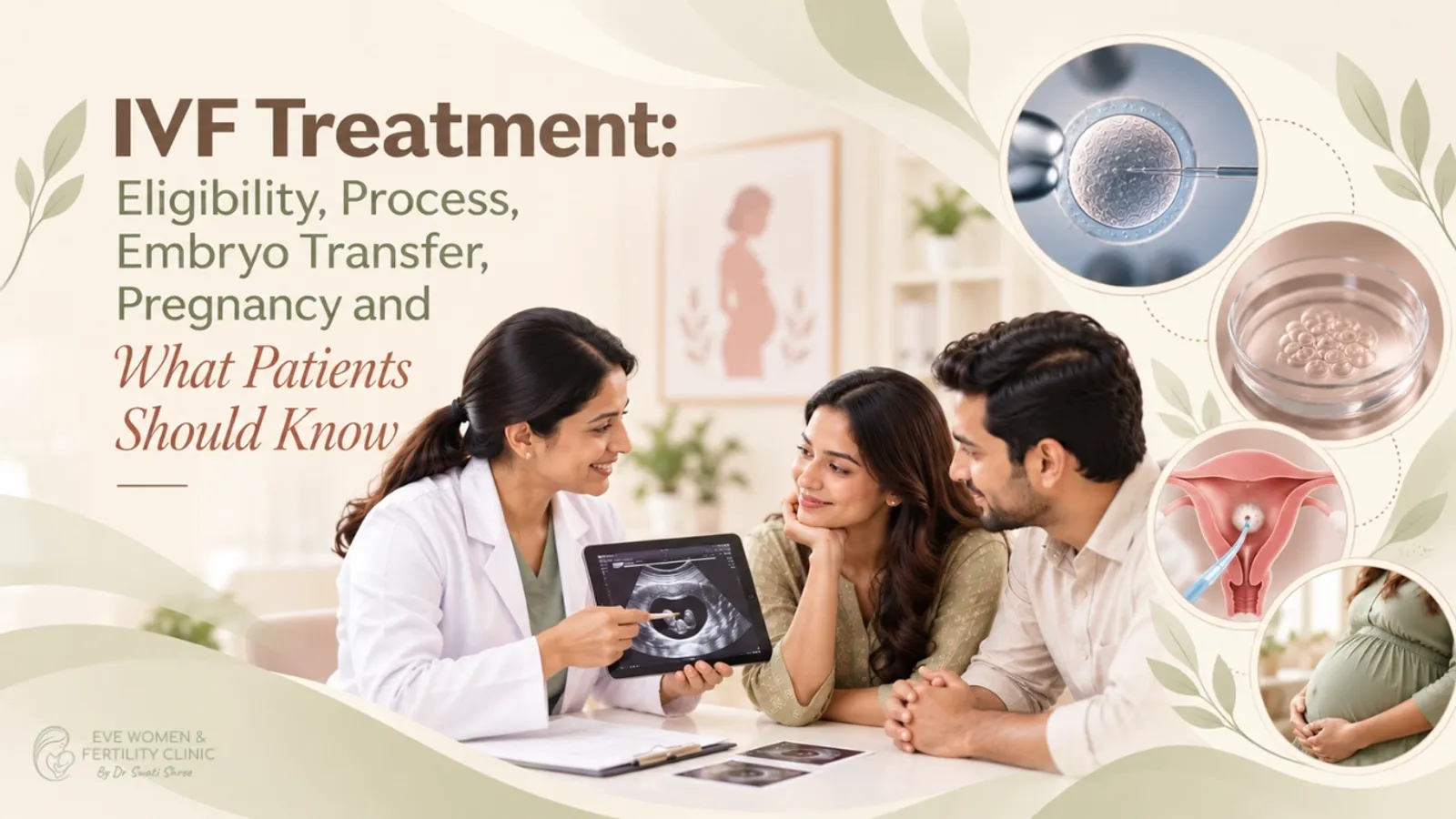
Quick answer: IVF combines eggs and sperm in a laboratory to create embryos, then places an embryo in the uterus. Doctors may suggest it for blocked tubes, severe male infertility, endometriosis, low ovarian reserve or unexplained infertility, or after IUI hasn't worked. One fresh cycle usually takes four to six weeks from the first injection to the pregnancy blood test.
IVF, or in vitro fertilisation, is a fertility treatment in which a woman's eggs are collected and fertilised with sperm in a laboratory. A few days later, an embryo is placed inside her uterus, where it may implant and develop into a pregnancy. In India it's often called "test tube baby" treatment, though the embryo spends those first days in a small culture dish, not a tube.
Doctors use IVF for a wide range of fertility problems. Blocked fallopian tubes, a low sperm count, endometriosis and infertility with no obvious cause are among the most common reasons.
Maybe a doctor has just mentioned IVF to you. Or maybe you've been trying for a while and want to know what the treatment involves before you sit across from a specialist. Either way, the sections below cover eligibility, each stage of a cycle, the risks, and what happens once a pregnancy test comes back positive.
What is IVF and how does it work?
Think about how conception happens naturally. Each month the ovary releases one egg, which is picked up by the fallopian tube. Sperm has to swim up to meet it there. If fertilisation happens, the early embryo drifts down into the uterus over several days and tries to implant.
A lot can go wrong along that route. The tube may be blocked. There may be too few healthy sperm to reach the egg. Ovulation may be irregular.
IVF takes the hardest parts of the process out of the body. Hormone medicines help several eggs mature in one cycle instead of just one. Those eggs are collected, fertilised in the lab, and watched as they grow. The doctor then transfers an embryo straight into the uterus, so it never needs to pass through the tubes at all.
Is IVF the same as a test tube baby?
Yes, the two terms mean the same treatment. Only fertilisation and roughly the first five days of growth happen in the lab. After transfer, the pregnancy develops inside the mother exactly as any other pregnancy would.
How is ICSI different from IVF?
ICSI (intracytoplasmic sperm injection) is a lab technique used as part of an IVF cycle, not a separate treatment. With standard IVF, the embryologist places each egg in a dish with many prepared sperm and lets fertilisation happen by itself. With ICSI, the embryologist picks out one sperm and injects it directly into the egg.
It's mainly used when sperm count, movement or shape is very poor, or when eggs didn't fertilise well in an earlier IVF attempt.
Who may need IVF treatment?
IVF usually isn't the first thing a fertility specialist tries. Plenty of couples conceive with ovulation tablets or IUI (intrauterine insemination), which are simpler and cost less. IVF tends to come in when those options are unlikely to work for a particular diagnosis, or when they've already been tried without success.
The situations where IVF is most often discussed include the following.
- Fallopian tubes that are blocked or damaged, for example after a pelvic infection, a previous ectopic pregnancy or surgery
- Severe male factor infertility, such as a very low sperm count or very few moving sperm
- Endometriosis, particularly when it's moderate to severe or involves the tubes and ovaries
- Low ovarian reserve, often picked up through a low AMH result
- PCOS that hasn't responded to ovulation medicines or IUI
- Unexplained infertility after a reasonable period of trying or a few IUI cycles
- Fertility decline linked to age, especially in the late 30s and 40s
- Certain genetic conditions where testing embryos may be discussed
- Freezing eggs or embryos before cancer treatment
A diagnosis on its own doesn't settle the question. Two women with endometriosis can have very different plans depending on age, AMH, the state of the tubes and the husband's semen report. That's why the decision is made after testing, not before.
Should you try IUI first?
Sometimes it makes sense, and sometimes it would only waste time. IUI can work reasonably well for younger women with mild sperm issues, ovulation problems or unexplained infertility. It can't help if both tubes are blocked, because the egg and sperm still need to meet inside the tube. It also does little for severe sperm problems.
| IUI | IVF | |
|---|---|---|
| Where fertilisation happens | Inside the body | In the laboratory |
| Medicines | Mild ovulation medicines, or none | Daily hormone injections for around 8 to 14 days |
| Main procedure | Washed sperm placed in the uterus | Egg collection under sedation, then embryo transfer |
| Needs at least one open tube | Yes | No |
| Helps with severe sperm problems | Rarely | Yes, often with ICSI |
| Cost and intensity | Lower | Higher |
Is IVF regulated in India?
It is. The Assisted Reproductive Technology (Regulation) Act, 2021 governs IVF clinics and banks in India. Clinics have to be registered, and the law covers consent, donors, record keeping and who can access treatment. Eligibility can turn on individual circumstances, so it's worth raising any questions about it directly with your clinic.
What tests are done before IVF?
Both partners get tested. The results tell your doctor what's causing the difficulty and help decide how much medicine to use, whether ICSI is needed, and whether anything in the uterus should be corrected first.
| Test | For | Why it's done |
|---|---|---|
| AMH blood test | Woman | Gives an estimate of how many eggs remain (ovarian reserve) |
| Antral follicle count scan | Woman | Counts small follicles in the ovaries early in the cycle |
| Day 2 or 3 hormones (FSH, LH, estradiol) | Woman | Shows how the ovaries and pituitary are working |
| TSH and prolactin | Woman | Picks up thyroid and prolactin problems that affect fertility and pregnancy |
| Transvaginal ultrasound | Woman | Looks for fibroids, polyps, cysts and checks the uterus |
| HSG or another tube test | Woman, if needed | Checks whether the tubes are open |
| Semen analysis | Man | Measures sperm count, movement and shape |
| HIV, hepatitis B and C and other screening | Both | Needed for safe handling of eggs, sperm and embryos |
If the scan hints at a polyp or something inside the uterine cavity, your doctor may suggest a hysteroscopy. A thin camera is passed through the cervix to look directly inside, and small problems can often be removed at the same time.
What happens during an IVF cycle?
Clinics differ in the details, but most IVF cycles follow the same broad sequence.
Step 1. Planning your treatment
Your doctor goes through your history, test results and any previous treatment. You'll talk about which stimulation protocol suits you, whether ICSI will be used, and whether a fresh or frozen transfer is more likely. Bring up costs and timelines here too. It's far easier to plan leave from work and family commitments when you know the dates in advance.
Step 2. Stimulating the ovaries
For roughly 8 to 14 days you'll take daily hormone injections that encourage several follicles to grow at once. (A follicle is a small fluid-filled sac in the ovary that holds an egg.) Another medicine is added partway through to stop the eggs being released too early.
Most of these are small injections given just under the skin of the belly. A nurse will show you how, and a lot of women end up doing them at home in a couple of minutes. Expect some bloating, tender breasts, tiredness and mood swings during these days.
Step 3. Monitoring
You'll come in every two or three days for a transvaginal scan, often with a blood test. The scans show how many follicles are growing and how fast, and your doctor uses them to adjust the dose. This is the same follicle monitoring, or follicular study, that's done in IUI cycles.
Step 4. The trigger injection
Once enough follicles reach the right size, you get one final injection to help the eggs finish maturing. Egg collection is booked for about 34 to 36 hours afterwards. The timing matters a great deal here, so take this injection at exactly the hour your clinic gives you.
Step 5. Egg collection
Egg collection, also called ovum pick-up, takes around 15 to 30 minutes. You're given sedation or light anaesthesia, so you won't feel the procedure. Guided by ultrasound, the doctor passes a fine needle through the vaginal wall into each follicle and draws out the fluid, which the embryologist checks for eggs.
Most women go home the same day. Cramping and a little spotting for a day or two are common.
Don't be thrown if the number of eggs is lower than the number of follicles seen on the scan. Some follicles are empty, and some eggs collected won't be mature enough to use.
Step 6. Fertilisation and embryo growth
The same day, your husband gives a semen sample, unless frozen or surgically retrieved sperm is being used. The eggs are fertilised by standard IVF or by ICSI.
Over the next three to five days the embryologist watches how the embryos divide. An embryo that keeps developing to day 5 or 6 is called a blastocyst, and many clinics prefer to transfer at this stage. Numbers usually drop each day as some embryos stop growing. Your clinic will call to update you, and the drop is expected.
Step 7. Embryo transfer
Transfer is quick and usually needs no anaesthesia. Most women compare it to a Pap smear. The doctor slides a very thin, soft catheter through the cervix under ultrasound guidance and releases the embryo inside the uterus. You may be asked to arrive with a fairly full bladder because it gives a clearer view on the scan.
Step 8. Waiting for the test
After transfer you'll usually take hormone support, most often progesterone, to support the lining of the uterus. The pregnancy blood test, called a beta hCG, is generally done 9 to 14 days after transfer, depending on the embryo's stage and your clinic's routine.
Try not to test at home before then. The trigger injection can leave enough hCG-like hormone in your body to show a false positive in the first days, and a test taken too early can just as easily show a false negative.
How long does the whole thing take?
| Stage | Roughly how long |
|---|---|
| Tests and planning | 2 to 4 weeks, sometimes more |
| Injections | 8 to 14 days |
| Trigger to egg collection | 34 to 36 hours |
| Embryo culture | 3 to 5 days |
| Transfer to blood test | 9 to 14 days |
So once injections begin, a fresh cycle takes about four to six weeks to reach the pregnancy test. If the embryos are frozen and transferred later, add another month or more.
Fresh or frozen embryo transfer?
With a fresh transfer, the embryo goes in a few days after egg collection, in the same cycle. With a frozen embryo transfer (FET), the embryos are frozen by a fast-freezing method called vitrification and transferred in a later month once the uterine lining has been prepared, either in a natural cycle or with hormone tablets.
| Fresh transfer | Frozen transfer | |
|---|---|---|
| When | 3 to 5 days after egg collection | A later cycle |
| Hormone levels at transfer | Still raised from the injections | Closer to normal |
| OHSS risk | Can be higher in women at risk | Lower |
| Often chosen when | Response was normal with no warning signs | OHSS risk is high, the lining isn't ready, or embryos are being tested |
Neither one is the better choice for everybody. Your doctor decides based on how your ovaries responded and how your hormone levels look around egg collection. A practical advantage of freezing is that any extra good embryos can be stored, so a second transfer may not require another round of injections.
How many embryos should be transferred?
The move worldwide has been towards transferring one embryo at a time, particularly for younger women with a good-quality blastocyst. Putting back two or more raises the odds of twins or triplets, and carrying multiples brings higher risks of premature birth, high blood pressure and diabetes in pregnancy.
You and your doctor will decide together, looking at your age, embryo quality, earlier cycles and the limits set under Indian law.
What affects the chances of IVF working?
No clinic can promise that IVF will result in a baby. What's possible is to understand the factors in your own case.
Age matters more than anything else. A woman's eggs fall in both number and quality as she gets older, and the change speeds up after 35. That's why two couples with the same diagnosis can have quite different outlooks.
Ovarian reserve plays a part too. AMH and the antral follicle count help predict how many eggs might be collected, though neither says much about egg quality. Embryo development matters, and embryos that reach the blastocyst stage generally implant more often. Sperm quality affects fertilisation and early growth, although ICSI can work around many sperm problems.
Then there's the uterus. Polyps, fibroids inside the cavity, scarring or a thin lining can make implantation harder, and some of these can be treated beforehand. Smoking, heavy drinking, and being very overweight or underweight also tend to lower the chances.
The success rates you see online are averages pooled across thousands of women of different ages and diagnoses. They may tell you very little about your own situation. A better question to put to your doctor is what your particular results suggest.
What are the risks and side effects of IVF?
For most women IVF goes smoothly, but there are some risks you should know before you start.
Ovarian hyperstimulation syndrome (OHSS)
OHSS happens when the ovaries overreact to the stimulation medicines. In its mild form you feel bloated and uncomfortable, and it settles in a few days. Severe OHSS is uncommon. Fluid can collect in the abdomen and sometimes around the lungs, and it needs hospital care. Women with PCOS or a high AMH are more prone to it. Doctors lower the risk by choosing the right protocol and trigger, and by freezing all embryos instead of transferring fresh when the risk is high.
Twins and triplets
The main cause is transferring more than one embryo. Transferring one at a time keeps this risk low.
Ectopic pregnancy
A pregnancy can still implant outside the uterus after IVF, most often in a tube. The early scan is partly there to rule this out.
Complications from egg collection
Bleeding, infection or injury to nearby organs can happen, but they're rare.
Side effects of the medicines
Headaches, hot flushes, bloating, mood changes and soreness where you inject are all common and usually pass once the injections stop.
The emotional load
Nobody warns you how tiring the waiting is. Waiting for scan results, waiting for the call from the lab, waiting through the two weeks after transfer. Add the cost and questions from relatives, and it's a lot to carry. Feeling worn down during IVF is common, and it says nothing about your strength.
Are babies born through IVF healthy?
The large majority are healthy and grow up like any other child. Some studies have found slightly higher rates of certain pregnancy complications after IVF, though part of that seems to relate to the underlying infertility, not the treatment itself. Your doctor can explain how this applies to you.
What happens after a positive IVF pregnancy test?
A positive result is the start of a few weeks of closer follow-up.
Your doctor may repeat the hCG blood test after two or three days to check that the level is rising the way it should. Keep taking your hormone support until you're told to stop. Stopping progesterone or other medicines on your own can be risky.
A transvaginal scan is usually done about two to three weeks after the positive test. It confirms that the pregnancy is inside the uterus and, often, shows a heartbeat. Once things look settled, your care moves to regular antenatal visits with your obstetrician.
Some spotting is quite common in early IVF pregnancies. Still, tell your doctor about any bleeding or pain so it can be checked.
What if the cycle doesn't work?
Sometimes good embryos don't implant, and nobody can fully explain why. When a cycle ends without a pregnancy, the disappointment can be heavy. Give yourselves time before deciding anything.
When you're ready, a follow-up consultation looks back at the whole cycle. How did the ovaries respond? How many eggs were mature? How did the embryos grow? Was the lining a good thickness? Sometimes more tests are needed. Many couples go on to conceive from a frozen embryo saved from the same cycle, or in a later cycle with a changed plan.
If your earlier IVF was at another centre, a second opinion can help you see whether anything should be done differently.
Diet, lifestyle and coping during IVF
There's no special IVF diet, whatever you may read on social media. Ordinary home food does the job. Dal, sabzi, curd, eggs or other protein, fruit, and whole grains such as millets, brown rice or rotis made from whole wheat give you what you need. If you have PCOS, cutting back on sweets, fried snacks and packaged food helps more than any supplement.
Stop smoking and avoid alcohol while you're in treatment. Keep tea and coffee to a couple of cups a day. Walking and gentle yoga are fine unless your doctor says otherwise. Sleep matters more than people think, and long hours in Bangalore's tech offices don't help, so plan scan days and the days after egg collection in advance with your manager if you can.
Only take supplements your doctor has recommended. Herbal powders and "fertility kadhas" from relatives haven't been tested for safety alongside IVF medicines.
On the emotional side, decide together how much you'll share and with whom. You don't owe your extended family a running update. Some couples find counselling or a support group useful. Others just need a few evenings where IVF isn't the topic of conversation.
Common IVF myths in India
"If a couple can't conceive, it's the woman's problem."
Male factors are involved in a large share of couples with infertility. That's why the husband's semen test is part of the first workup, not something done later.
"IVF babies aren't normal."
The embryo spends about five days in the lab. After that, the pregnancy and the baby develop exactly the same way any other pregnancy does.
"You must stay in bed after embryo transfer."
Studies haven't shown that bed rest helps the embryo implant. Light normal activity, including going back to desk work, is generally fine.
"IVF works the first time."
For some couples it does. Many others need more than one transfer or cycle, depending on age and diagnosis.
"IVF always means twins."
Twins happen mostly when two or more embryos are transferred. One embryo at a time keeps that chance low.
"With low AMH, IVF won't work."
Low AMH usually means fewer eggs are collected in a cycle. It doesn't measure egg quality, and it doesn't rule out a pregnancy.
How much does IVF cost in Bangalore?
There's no single figure, because the total depends on your treatment. The biggest variable is usually the medicine dose, which depends on your ovarian reserve and response. ICSI, embryo freezing and storage, the type of transfer, extra procedures such as hysteroscopy, embryo testing or surgical sperm retrieval, and the number of cycles you need all change the cost.
Before you start, ask for a written estimate that spells out what's included and what isn't.
Questions worth asking your fertility doctor
- Why IVF for us, and not IUI or another option?
- Based on our reports, what are our chances?
- Will we need ICSI?
- What protocol will I be on, and what's being done to lower my OHSS risk?
- Do you expect a fresh or frozen transfer, and how many embryos?
- What happens to embryos we don't use?
- What will the full cycle cost?
- Who do we call at night or on a Sunday if something feels wrong?
How is IVF planned at EVE Women and Fertility Clinic?
At EVE Women and Fertility Clinic in Gunjur, Bangalore, Dr. Swati Shree starts with a full evaluation of both partners. She goes through your history, AMH and hormone results, ultrasound findings and semen report, and looks first at whether ovulation induction or IUI could reasonably work for you.
If IVF is the right next step, Dr. Swati Shree assesses you at EVE and guides your IVF treatment through her partner fertility centres in Bangalore, Apollo Fertility and Motherhood Fertility, where she is a visiting consultant. Egg collection, the IVF laboratory work, embryo freezing and embryo transfer are carried out at these partner centres, while the same doctor stays with you through the whole process.
EVE is a registered ART Level 1 clinic, close to Varthur, Whitefield, Sarjapur Road and Bellandur.
When should you get urgent medical help during IVF?
Call your doctor straight away, or go to the nearest emergency department, if any of the following happen.
- Severe belly pain or bloating that keeps getting worse after injections or egg collection
- Breathlessness, or passing much less urine than usual
- Putting on weight quickly over a day or two during treatment
- Fever or foul-smelling discharge after a procedure
- Heavy bleeding from the vagina
- Pain on one side of the pelvis, pain at the tip of the shoulder, dizziness or fainting in early pregnancy
The first three can point to OHSS. The last can be a sign of ectopic pregnancy.
When should you see a fertility specialist?
Most guidelines suggest getting checked if you're under 35 and haven't conceived after a year of regular unprotected sex, or if you're 35 or older and it's been six months. At 40 and above, it's sensible not to wait.
See someone sooner if your periods are very irregular or have stopped, if you already know you have PCOS, endometriosis, fibroids or a thyroid problem, or if you've had a pelvic infection, an ectopic pregnancy or pelvic surgery. The same applies if your husband has a known sperm problem, if you've had two or more miscarriages, or if earlier IUI or IVF hasn't worked.
Getting evaluated doesn't commit you to IVF. Often it simply means you get answers earlier.
Key Takeaways
- IVF fertilises eggs with sperm in a lab and places an embryo in the uterus.
- It's commonly used for blocked tubes, severe male factor infertility, endometriosis, low AMH, unexplained infertility and after unsuccessful IUI.
- A fresh cycle usually takes four to six weeks from the first injection to the blood test.
- ICSI is a lab technique within IVF, used mostly for sperm problems.
- Single embryo transfer lowers the risk of twins and triplets.
- The woman's age has the biggest effect on the chance of success.
- OHSS and ectopic pregnancy are the two complications to watch for most closely.
- Both partners should be tested, and emotional support deserves the same attention as the medical side.
Final Thoughts
- Medical Disclaimer
- This article is for educational purposes only and does not replace professional medical advice. Fertility treatment outcomes vary from person to person. Please consult a qualified doctor for diagnosis and treatment.
Most couples come to IVF after months or years of trying, and it's normal to feel hopeful and nervous at once. Knowing what each stage involves, what affects your chances and which symptoms need attention takes a lot of the fear out of it.
IVF won't work in every cycle for every couple. It has, though, helped a great many couples who had started to lose hope. What matters most is a plan built around your own test results, health and priorities.
If you'd like to find out whether IVF is right for you, or what else might help first, you can book a fertility consultation with Dr. Swati Shree at EVE Women and Fertility Clinic, Gunjur, Bangalore.
More in this series
FAQs
Does IVF hurt?
Most of IVF involves only mild discomfort. The daily injections feel like a quick pinch, and many women give them at home after a nurse shows them how. Egg collection is done under sedation or light anaesthesia, so you won't feel it, though cramping afterwards is common. Embryo transfer feels much like a Pap smear and usually needs no anaesthesia.
How many days of injections does IVF need?
Stimulation injections usually run for 8 to 14 days. The exact number depends on your ovarian reserve and how your ovaries respond, which your doctor tracks with scans every few days. When the follicles are ready, you get a trigger injection, and egg collection follows about 34 to 36 hours later.
Do I need bed rest after embryo transfer?
No. Research hasn't found that lying in bed after transfer improves the chance of pregnancy. Most women go back to light routine activities, including office work, within a day or so. It's sensible to skip heavy lifting and strenuous workouts for a while, and to follow any specific advice your fertility team gives you.
Can IVF work if my AMH is low?
It can. Low AMH usually means fewer eggs are collected in each cycle, but AMH doesn't measure egg quality, and it doesn't rule out pregnancy. Your doctor may change the stimulation plan to suit a lower reserve. Your age and other test results also shape your chances, so a personal consultation gives the clearest picture.
What's the difference between IVF and ICSI?
In standard IVF, each egg is placed in a dish with many sperm and fertilisation happens on its own. In ICSI, an embryologist injects a single sperm directly into each mature egg. ICSI is done as part of an IVF cycle, usually for a low sperm count, poor sperm movement, or poor fertilisation in an earlier attempt.
When can I take a pregnancy test after IVF?
The beta hCG blood test is usually done 9 to 14 days after embryo transfer, depending on the embryo's stage and your clinic's advice. Home tests taken earlier can mislead you. The trigger injection may cause a false positive in the first days, and testing too soon can also give a false negative.
Where can I see a fertility specialist about IVF in East Bangalore?
Dr. Swati Shree consults at EVE Women and Fertility Clinic in Gunjur, which is convenient from Varthur, Whitefield, Sarjapur Road and Bellandur. She evaluates couples at EVE, and when IVF is needed she manages treatment through her partner fertility centres in Bangalore, so the same specialist oversees your care from start to finish.